
finding a job
cover letter


If you've spent any time looking for career advice, you've come across some version of this statistic: "80% of jobs are never advertised."
The number changes depending on the source. Sometimes it's 70%. Sometimes 85%. The message is always the same: the best opportunities are hidden, and you need insider access to find them.
So where does this number actually come from?
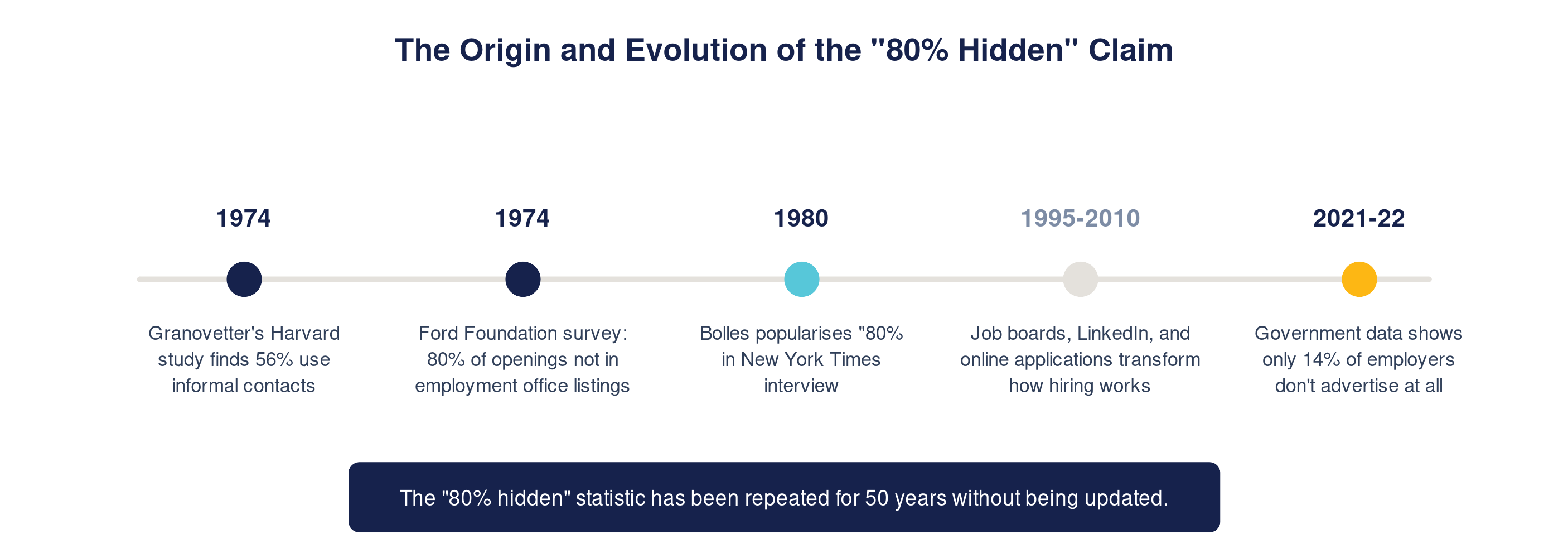
The "80% hidden" claim can be traced back to a 1974 Ford Foundation-funded survey conducted in Rochester, New York, which found that 80% of existing job openings didn't appear in employment office listings or want ads. It was later popularised by Richard Bolles in What Color Is Your Parachute?, who repeated it in a 1980 New York Times interview [1].
The actual academic research behind it is Mark Granovetter's landmark Getting a Job: A Study of Contacts and Careers, which found that 56% of successful job searches used informal contacts [2]. That's a meaningful number, but it's a long way from 80%.
More importantly, that research was conducted over 50 years ago, before job boards, LinkedIn, or online applications existed. The job market has changed fundamentally since then.
There's no single definitive study that gives us a clean, updated number. But there is enough credible government research to paint a much clearer picture than a 50-year-old statistic.
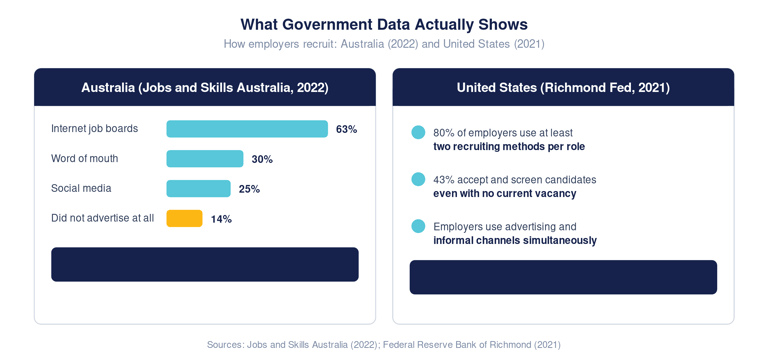
In Australia, the government's Jobs and Skills Australia agency publishes data on how employers actually recruit, based on their Recruitment Experiences and Outlook Survey. In 2022, 63% of recruiting employers advertised on internet job boards, 30% used word of mouth, and 25% used social media. Notably, only 14% of employers did not advertise their most recent vacancy at all, relying solely on word of mouth or direct approaches [3]. That's a long way from the claim that 80% of jobs are hidden. The majority of employers are actively advertising.
In the United States, the Federal Reserve Bank of Richmond published research in 2021 based on surveying 308 employers across three waves. Their findings add important nuance. 80% of employers reported using at least two recruiting methods per open job [4]. This is a critical point: most employers aren't choosing between advertising and informal channels. They're using both simultaneously.
The Richmond Fed research also found that 43% of employers accept applications and screen candidates even when they have no immediate vacancy to fill [4]. This means a significant proportion of roles are being filled from a pipeline that was built before the job was ever formally "open." These roles aren't hidden in the traditional sense. They're just being filled from an existing pool rather than a fresh advertisement.
The picture that emerges is more complicated than either side of the debate suggests. The job market isn't 80% hidden. But it's not 100% advertised either. Most employers use multiple channels at once, a meaningful minority don't advertise at all, and many are recruiting before roles formally exist.
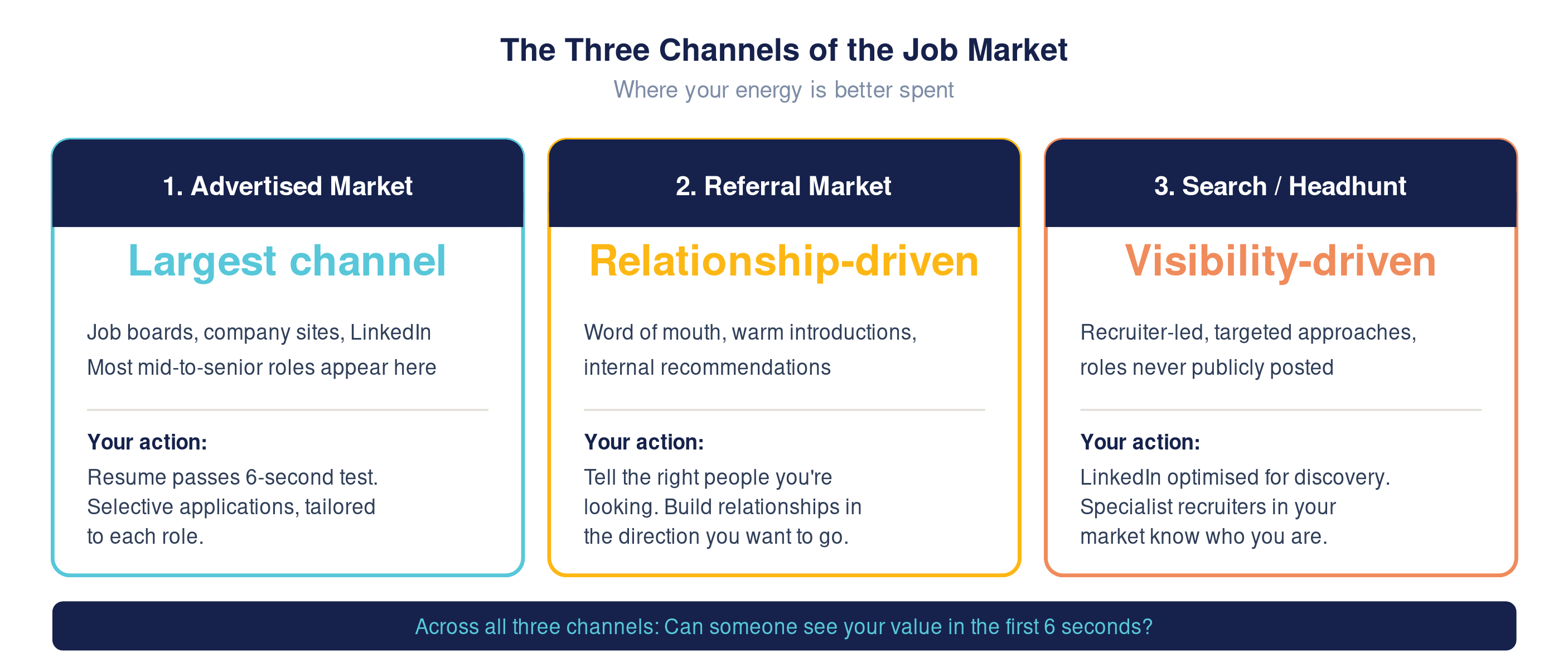
After 16 years in recruitment, that matches what I've seen. The job market operates across three channels simultaneously. And understanding how all three work gives you a much clearer picture of where your energy should go.
I've worked across corporate, government, and not-for-profit sectors. I've filled hundreds of roles and partnered with hiring managers at all levels.
Here's what actually happens.
The majority of mid-to-senior roles are advertised. They're on job boards, company websites, and LinkedIn. They have to be. Most organisations have procurement policies, diversity requirements, or internal governance that requires them to run a fair, open process.
Government roles are almost always advertised. Large corporates with HR compliance requirements are almost always advertised. Even organisations that use recruitment agencies typically advertise the role in parallel.
The advertised market is real. It's where most hiring happens. And it's where the vast majority of experienced professionals will find their next role.
The problem isn't that the jobs aren't there. The problem is what happens after you apply. I'll come back to that.
This is where the "hidden job market" claim has a grain of truth, even if it's been exaggerated.
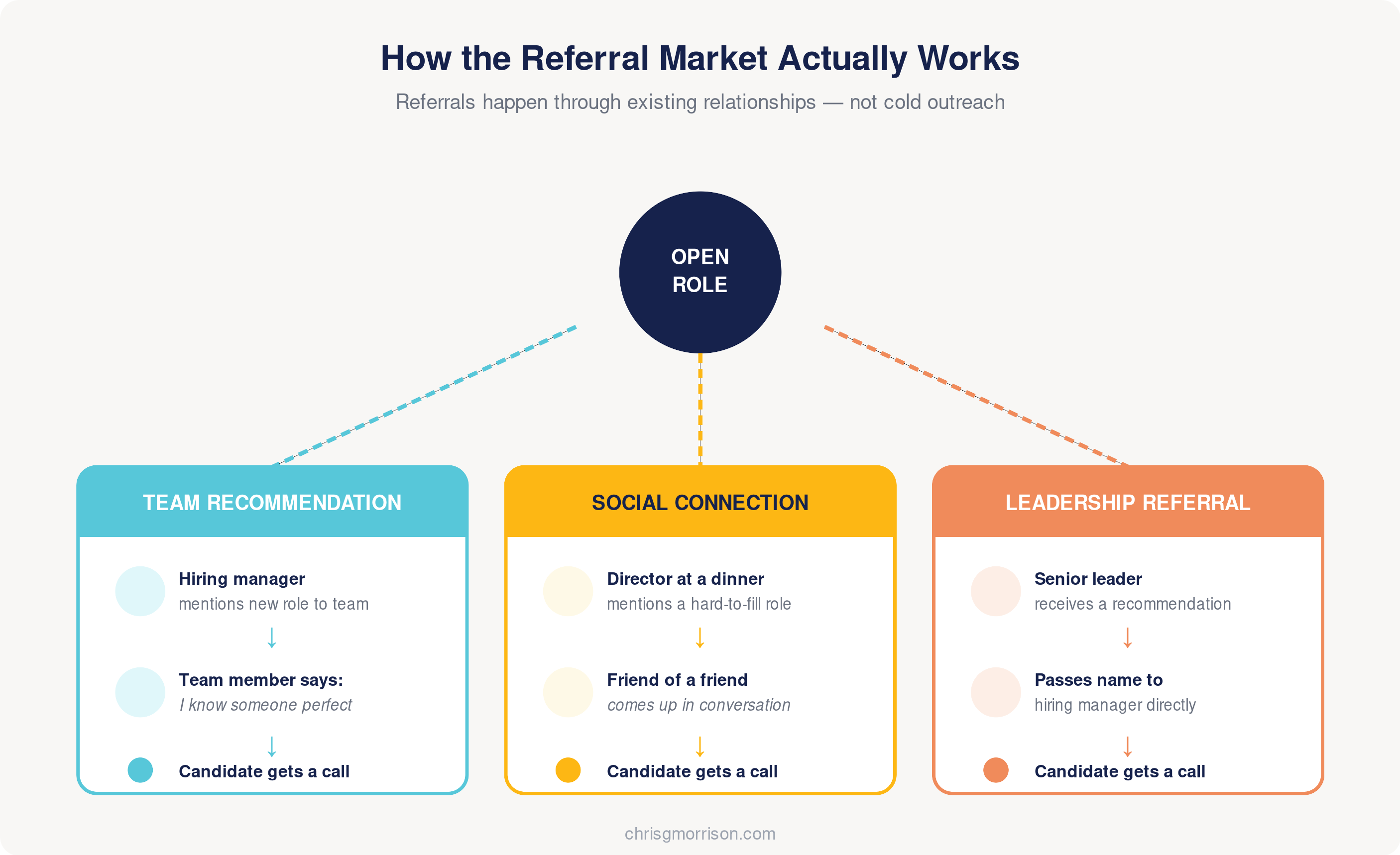
Referrals do lead to hires. And they happen from more angles than most people realise.
A hiring manager mentions a new role to their team and someone says, "I know someone who'd be great for that." A director mentions at a dinner party that they're struggling to fill a position, and a friend of a friend comes up. A senior leader tells a hiring manager, "Someone was recommended to me recently. You might want to look at them for your role."
If you're top of mind when any of those conversations happen, you might get a call before the role is even posted. That's real, and it happens regularly.
But here's what the career coaching industry gets wrong about this.
They frame it as a strategy you can execute during a job search. Reach out to people, attend networking events, send messages on LinkedIn, and you'll tap into these hidden opportunities.
That's backwards.
The referral market doesn't work because you reached out to someone last week. It works because someone already knows what you're capable of and thinks of you at the right moment.
That means there are two things worth doing.
First, make sure your existing network knows you're looking. This sounds obvious, but most people don't do it. If you're exploring opportunities and the people who know your work don't know that, they can't help you. You don't need to broadcast it publicly. A few targeted conversations with people who are well-connected in your industry can be enough.
Second, grow your network in the direction you want to head. If you're aiming for a more senior role, or a role in a new sector, the people who can refer you into those opportunities are probably people you don't know yet. Building those relationships takes time. It's a long-term investment, not a job search tactic.
The referral market is real. But it rewards people who've been building relationships consistently, not people who start networking when they need something.
This is the channel that most job seekers don't think about at all. And in the current market, it's becoming more relevant.
Here's what's happening right now. There are several legitimate reasons why an employer might choose not to advertise a role at all.
Sometimes it's about confidentiality. The organisation is replacing someone who doesn't know they're being moved on, or they're building a team for a strategic initiative they don't want competitors to know about. Advertising would tip their hand.
Sometimes it's about not wanting to signal to the market. If a company advertises a senior leadership role, it tells their competitors, clients, and even their own staff that something is shifting. A quiet search avoids that entirely.
And sometimes it's simply about volume. When a company advertises a mid-to-senior role right now, they're routinely receiving 300 to 400 applications. For hiring managers, that's overwhelming. The screening process becomes a bottleneck, and the quality of the long list drops because the recruiter is making faster decisions under more pressure.
In all of these cases, I'm increasingly recommending to my clients that they don't advertise at all. Instead, we run a targeted search or headhunt approach. We identify the right candidates, approach them directly, and build a short list of people we know are qualified.
This means there are roles out there that you will never see on a job board. Not because they're being hoarded or hidden, but because the employer has made a deliberate decision that a targeted search serves them better than an open process.
For you as a job seeker, this has a specific implication.
If a recruiter doing a headhunt doesn't know you exist, they can't approach you.
That means two things matter.
Your LinkedIn profile needs to be optimised for discovery. When a recruiter is searching for candidates, they're using keywords, job titles, skills, and industry terms. If your LinkedIn profile doesn't contain the right language, you won't appear in their search results. This isn't about gaming the algorithm. It's about making sure the way you describe yourself matches the way recruiters search.
The right recruiters need to know who you are. If you're a senior finance professional, the recruiters who specialise in finance and accounting in your market should know your name. Not because you're pestering them with calls, but because you've had a conversation, you've shared what you're looking for, and you're on their radar for when the right brief comes across their desk.
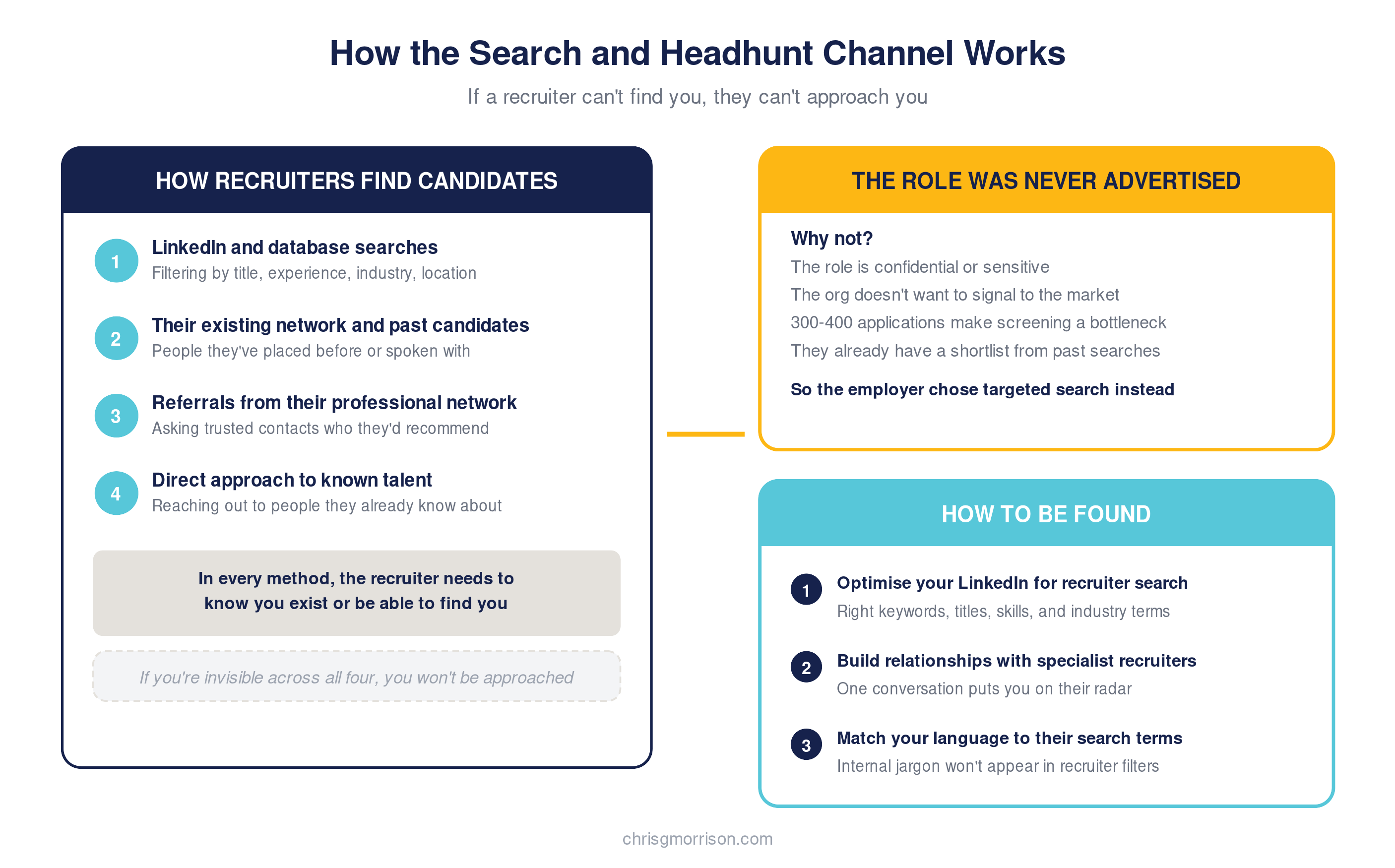
This isn't networking in the general sense. It's a targeted, practical step that takes very little time and puts you in a channel that most people ignore completely.
Partly because it was true once. In 1974, before online job boards existed, a much larger proportion of roles were filled informally. Granovetter's research was valid for its time [5].
But the statistic has been repeated for 50 years without being updated. And it's useful for people who sell networking strategies, job search coaching, or access to "insider" connections.
It reframes the problem. Instead of "your application isn't landing well," the story becomes "you're looking in the wrong places." That's a more comfortable explanation, and it's easier to sell.
It also creates dependency. If you believe the best jobs are hidden, you need someone to show you where they are.
I'm not suggesting everyone promoting this idea is doing it cynically. Many genuinely believe it. But when government data from both Australia and the US shows that the majority of employers do advertise their roles, and the original academic research found 56% (not 80%) of job searches used informal contacts, the claim needs updating. And treating it as the whole picture sends people in the wrong direction.
Across all three channels, one thing stays consistent.
When a hiring manager, recruiter, or referral contact looks at your resume or LinkedIn profile, they need to be able to see your value quickly.
Most mid-to-senior roles receive somewhere between 100 and 400 applications, or a recruiter is reviewing a headhunt shortlist under time pressure. In both cases, the person reviewing your profile is spending an average of 6 seconds deciding whether to keep reading.
If those 6 seconds don't clearly answer who you are, what level you operate at, and what kind of results you deliver, the outcome is the same regardless of which channel brought you there.
That means the highest-return activity for most experienced professionals isn't finding more jobs to apply for. It's making sure that when someone looks at your resume or profile, the answer is immediately obvious.
Based on what I've seen across thousands of hiring decisions, here's where I'd focus.
Your resume and LinkedIn profile need to pass the 6-second test. Your first page should clearly answer the key questions every hiring manager is asking. If a stranger looked at your resume for 6 seconds, could they tell you what level you operate at, what kind of results you deliver, and whether you're a fit for the role? If not, that's the first thing to fix.
Your achievements need to be specific. "Managed a team of 12" tells me what your job was. "Built and led a 12-person team that delivered $4.2M in new revenue" tells me what you actually achieved. That distinction is what separates the "yes" pile from the "maybe" pile.
Your language needs to match theirs. Your resume is written from your perspective, using your company's internal terminology. The hiring manager is reading it through the lens of their job description. If those two languages don't align, you look like a weaker fit than you are. The same applies to your LinkedIn profile when a recruiter is searching.
Be selective about where you apply. If you're applying broadly to anything that looks vaguely relevant, your application quality drops because you can't tailor effectively. Being selective about which roles deserve your full effort usually produces better results than applying to everything.
Tell the right people you're looking. A few targeted conversations with well-connected people in your industry can open the referral channel without requiring you to become a professional networker.
Get on the radar of specialist recruiters in your market. One conversation with the right recruiter can put you in a channel that most job seekers don't even know exists.
The job market isn't hidden. But it's more complex than a single statistic suggests.
Most roles are advertised, and you'll find your next opportunity by applying well. Some roles come through referrals, and that rewards people who've invested in relationships over time. And some roles are filled through direct search, where being visible and findable is what gets you in the room.
The question worth asking isn't "where are the hidden jobs?"
It's "across all three channels, can someone see my value in the first 6 seconds?"
If the answer is yes, you're in a strong position regardless of how the opportunity reaches you.
If the answer is no, that's where your time is best spent.
FREE RESOURCE
I've put together a free guide that walks through the five most common resume mistakes I see from experienced professionals.
It takes about 10 minutes to read and includes a quick fix for each one.
You can grab it here: 5 Resume Mistakes That Get You Rejected in 6 Seconds
[1] College Recruiter (2024). Is it true that 80% of job openings are not advertised? Covers the origin of the Bolles/NYT 1980 claim.
[2] Granovetter, M. (1974). Getting a Job: A Study of Contacts and Careers. Harvard University Press.
[3] Jobs and Skills Australia (2022). Recruitment Methods Used by Employers. Recruitment Experiences and Outlook Survey. Australian Government.
[4] Lester, R. & Nguyen, T. (2021). How Do Employers Recruit New Workers? Economic Brief No. 21-28, Federal Reserve Bank of Richmond.
[5] Preston, J. (2019). Hidden Origins of the Hidden Job Market, Part 2: The 80% Statistic Survey.