
finding a job
cover letter

Your resume gets about six seconds on the first pass. That's not time to impress me with vocabulary. It's time to show me you actually accomplished something.
After 16 years reviewing resumes, I've noticed something consistent: candidates confuse having better words with having a better resume. They'll swap "responsible for" with "spearheaded" and call it done. But "spearheaded a cost reduction initiative" tells me nothing. "Spearheaded cost reduction initiative that saved $180K annually" tells me something real.
The gap between those two sentences is everything. The verb gets the door open. The outcome is what makes me keep reading.
You've probably read somewhere that recruiters scan resumes for keywords, or that the right verbs help you get past the ATS, or that strong language signals competence. All of that's technically true. But here's what actually happens.
When I scan a resume, my brain is working on pattern recognition. I'm looking for signals that indicate you've done real work at real scale with actual results. Passive language creates friction. It forces me to work harder to understand what you contributed. The truth is that I rarely do that extra work. I move to the next candidate instead.
Active verbs change that. They create immediate clarity about your agency. "Managed budget allocation across five departments" takes two seconds to understand. "Allocated resources to departmental needs" reads as vague. The second one probably meant the same thing, but it sounds like you were following a process instead of making decisions.
There's also something about precision that signals competence. Candidates who choose exact language come across as more thoughtful. They sound like they've actually reflected on what they did and why it mattered. Vague language suggests the opposite - either you didn't do anything particularly meaningful, or you can't articulate it clearly.
What I've noticed is that this distinction separates candidates I want to interview from those I don't. Not because they did different work, but because they described it differently.
Let me show you what I mean. Here are the kinds of phrases I see constantly:
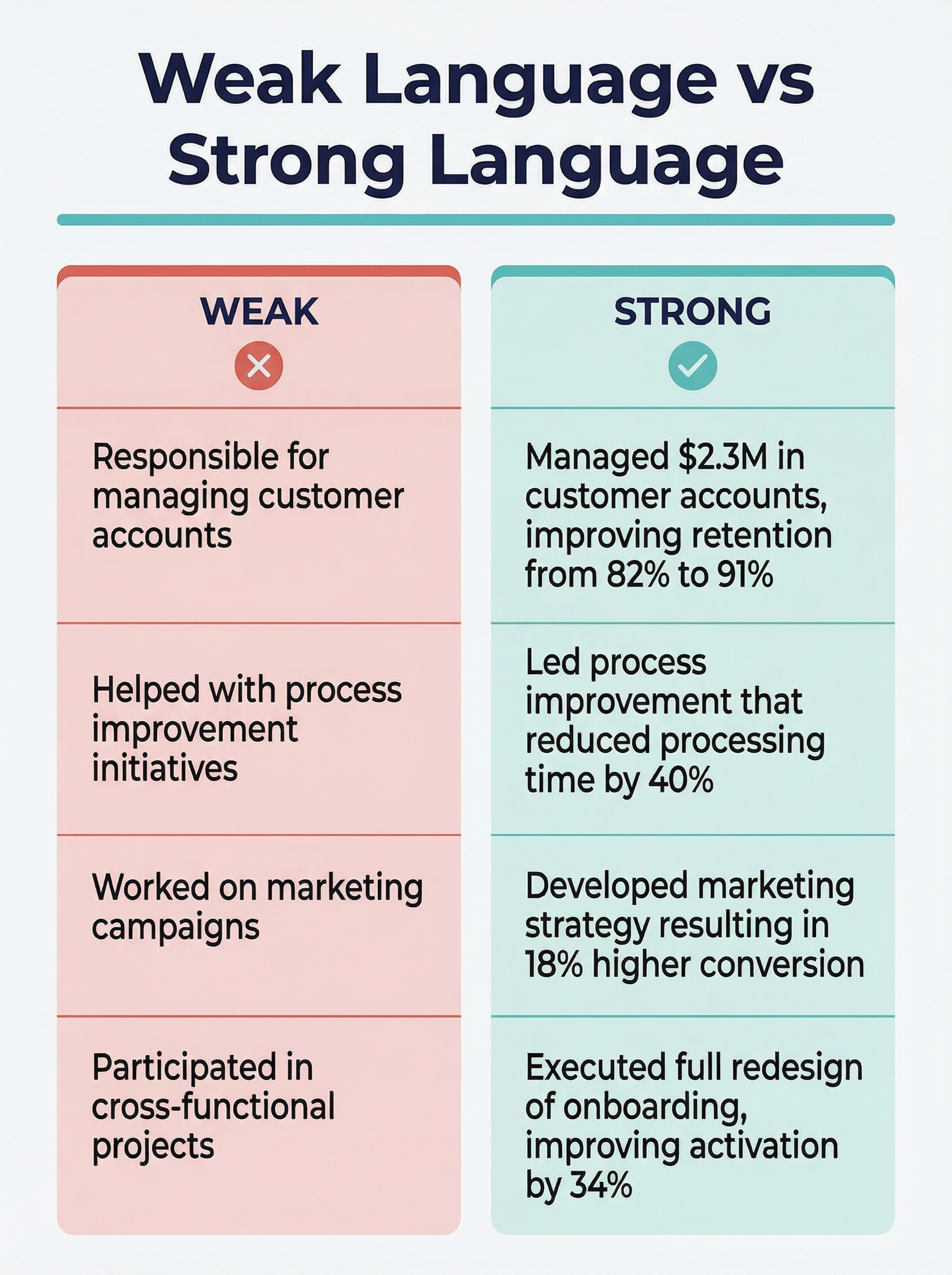
"Responsible for managing customer accounts." That's the baseline statement. It tells me you had customer accounts. It doesn't tell me what success looked like for you.
"Helped with process improvement initiatives." That tells me you were in the room. It doesn't tell me if you drove the initiative or just attended meetings.
"Worked on marketing campaigns." That's so vague I can't tell if you were the strategist or the person who scheduled social media posts.
"Participated in cross-functional projects." I have no idea what your actual role was or what you contributed.
The pattern here is distance. These phrases put space between you and your work. They sound like you were present but not necessarily responsible. And part of the reason that matters is that I'm trying to assess how much impact you can have in the next role. If I can't tell what you drove versus what you just attended, I'm going to assume the smaller impact.
Replace these weak constructions with accurate active verbs:
"Managed $2.3M in customer accounts, improving retention rate from 82% to 91%" - now I can picture your actual scope and impact.
"Led process improvement initiative that reduced order processing time by 40%, from five days to three" - now I know you drove it, and I know the outcome.
"Developed marketing strategy for Q2 product launch, resulting in 18% higher conversion rate than previous launches" - now I understand your specific contribution.
The difference isn't just grammar. It's clarity. It's specificity. It's evidence.
You shouldn't be searching a list every time you write a bullet point. What you need is a personal bank of verbs that actually describe your work - organised by the type of activity, not just alphabetically.
Let me walk you through how I approach this.
Start by thinking about the kinds of activities you performed in your recent roles. Not everything you did, just the major categories. Most professional work falls into these buckets:
Leadership and direction: Did you make decisions, set strategy, or guide other people's work? That's one category. Did you manage individual contributors? That's slightly different. Did you guide a project through uncertainty? That's leadership, but different from team management.
Analysis and problem-solving: Did you investigate issues, assess situations, or figure out what was broken? Did you design solutions? Did you test or validate approaches?
Growth and efficiency: Did you expand something - revenue, reach, capability? Did you improve something - speed, quality, cost?
Communication and influence: Did you persuade people, present to stakeholders, or document complex ideas? Did you negotiate or advocate?
Now, within each of those categories, there are different intensities of action. You can be more or less central to the outcome. The verbs you choose should match your actual role.
If you led strategic initiatives, you need verbs that convey authority and ownership:
Strong leadership verbs: Directed, Orchestrated, Spearheaded, Championed, Pioneered, Steered, Established, Instituted
Here's how those look in a complete bullet:
"Spearheaded company-wide digital transformation, directing cross-functional teams across product, engineering, and operations to migrate from legacy systems to cloud infrastructure, reducing deployment cycle time from six weeks to five days and improving system uptime from 94% to 99.7%."
That's a real bullet. It establishes the scope (cross-functional, company-wide), your role (you spearheaded and directed it), the complexity (legacy to cloud), and the impact (three specific metrics: cycle time reduction, uptime improvement).
If you managed people directly, you need verbs that show you developed talent and drove performance:
Team management verbs: Supervised, Mentored, Coached, Developed, Built, Scaled, Recruited, Empowered
"Built and scaled engineering team from four to twenty-two people over three years, developing a mentorship program that achieved 95% internal promotion rate for management positions."
What makes that strong is that it shows both growth (four to twenty-two) and quality (95% internal promotions). It demonstrates you didn't just hire - you built capability.
If you managed projects or initiatives without people-management responsibility, you need verbs that show you owned the outcome:
Project oversight verbs: Managed, Coordinated, Executed, Implemented, Launched, Delivered, Prioritised, Scheduled, Facilitated
"Executed full redesign of customer onboarding process, coordinating across product, support, and engineering to reduce time-to-value for new users from three weeks to five days and improving activation rate by 34%."
Notice the structure: verb + what you did + measurable change. That pattern works across roles.
If you grew something - revenue, users, market share, capability - your verbs should convey expansion:
Growth verbs: Grew, Scaled, Expanded, Increased, Built, Developed, Launched, Captured, Won
"Grew revenue from company's APAC division 127% over two years, expanding distribution network from eight to thirty-two partners and penetrating three new markets (Australia, Singapore, New Zealand)."
Growth isn't just about the top-line number. That bullet also shows how you achieved it (partner expansion, market entry). That context matters.
If you improved efficiency or reduced waste, your verbs should convey problem-solving and optimisation:
Efficiency verbs: Optimised, Streamlined, Automated, Reduced, Eliminated, Improved, Enhanced, Refined, Accelerated
"Optimised inventory management system across twelve distribution centres, reducing carrying costs by $840K annually while improving stock availability from 89% to 97.3%."
Here's where precision matters. "Reduced costs" is vague. "$840K annually" is credible. And when you pair it with the availability improvement, you show it wasn't just cost-cutting - it was smarter operations.
For innovation or process redesign, different verbs:
Innovation verbs: Architected, Designed, Engineered, Developed, Created, Conceptualised, Transformed, Reinvented
"Architected new pricing model based on customer usage data, transforming go-to-market strategy and increasing average customer lifetime value by 43% while maintaining churn at industry-leading 2.1% annually."
What this means is that you're showing the strategic thinking, not just the execution. You designed something new, not just implemented what someone else planned.
When you diagnose problems or analyse situations, the verbs should show investigation and insight:
Analysis verbs: Analysed, Assessed, Investigated, Diagnosed, Evaluated, Identified, Audited, Measured, Quantified
"Analysed customer support ticket data across 15,000 cases over 18 months, identifying that 34% of issues stemmed from three specific product areas, enabling engineering to prioritise fixes that reduced repeat ticket rate by 41%."
Notice that the analysis has a purpose. You're not just focused on analysis for its sake alone; you're identifying something actionable. That's the difference between "did research" and "created insight."
When you communicated complex ideas, presented to leadership, or negotiated outcomes, the verbs matter differently:
Communication and persuasion verbs: Presented, Influenced, Advocated, Negotiated, Convinced, Persuaded, Articulated, Drafted, Documented
"Presented quarterly performance analysis to C-suite executives, advocating for three significant operational changes based on data analysis. Two recommendations were implemented, resulting in $2.1M annual cost savings."
That's powerful because it shows both your communication skill (you presented to the C-suite) and your ability to influence (your recommendations were adopted with measurable impact).
Let me show you how this works in practice by taking a weak resume section and rebuilding it.
Original version:
"Responsible for managing a team of six marketing professionals. Worked on developing marketing strategies and campaigns. Helped with the launch of several new products. Assisted with improving website performance. Participated in vendor negotiations."
That's five different things with no outcomes, no scale, and no clarity about your actual role. Here's what strong looks like:
Rewritten version:
"Led cross-functional marketing initiatives for a 50-person growth team, managing six direct reports responsible for $18M in annual marketing budget. Orchestrated go-to-market strategies for four major product launches, achieving 23% higher customer acquisition than historical average. Directed vendor negotiations for marketing technology platform replacement, securing 35% cost reduction and faster deployment capability, impacting all campaigns launched in the subsequent 18 months."
What changed? Every claim now has evidence. You didn't just launch products - four launches with quantified results. You didn't just negotiate specific savings. You didn't just manage a specific team size and budget responsibility.
Here's another example:
Original:
"Contributed to team goals. Improved processes. Participated in meetings with stakeholders. Helped with reporting."
Rewritten:
"Improved operational efficiency for order fulfilment team by redesigning process workflow, reducing manual handoffs from nine steps to four and cutting average order processing time from 4.2 hours to 1.8 hours. Implemented new reporting system that automated 40% of previous manual reporting work, saving the team sixteen hours weekly and providing real-time visibility to leadership."
The rewritten version shows you didn't just participate - you identified problems and solved them with specific impact.
Looking to avoid the most common resume mistakes? Download the free guide: 5 Resume Mistakes That Get You Rejected in 6 Seconds and see what might be holding you back.
Different roles and industries value different language. Part of the reason for that is that organisations use specific terminology to describe their work. When your resume echoes that language, it signals that you understand how they think about the work.
Read the job posting carefully. Highlight every action verb used to describe the role. If they say "drive revenue growth," use "drove" in your relevant bullets. If they emphasise "building collaborative relationships," use "built" or "developed" rather than "supported."
This isn't about keyword stuffing. It's about speaking the same professional language as your target employer. When your resume uses the verbs and concepts from their posting, it feels more aligned.
Here's a practical approach: open a job description and a blank document side by side. For each major responsibility in the job posting, write down the verbs they use and the outcomes they emphasise. Then look at your resume. Do your bullets mirror that language and focus? If not, rewrite them to align.
Let's say a job posting says "We're looking for someone to lead product strategy and drive user adoption." Your resume should have bullets that use "led," "drove," or similar action verbs paired with adoption metrics, market expansion, or user growth numbers.
If the posting emphasises "maintaining compliance and implementing controls," your bullets should use verbs like "implemented," "established," "audited," "ensured," paired with evidence of compliance outcomes.
The reality is that this matching doesn't force you to lie. It forces you to present your experience in the language and framework your target employer uses. And that's valuable because they're more likely to recognise themselves in your description.
Using the same verb repeatedly throughout your resume creates monotony and suggests a limited vocabulary. But there's a balance here. You don't want to sacrifice accuracy for the sake of variety.
The solution is to create a personal verb bank before you start writing. Pick verbs from the categories above that honestly describe your different roles and achievements. Use each one once, maybe twice. That creates natural variety without forcing it.
Here's an example. Let's say you had three roles where you led initiatives:
"Directed a company-wide cost reduction initiative" (first role)
"Orchestrated the integration of two acquired companies" (second role)
"Championed a cultural transformation program focused on psychological safety" (third role)
Same type of leadership, three different verbs, three different contexts. It reads naturally and shows you can take on different kinds of leadership challenges.
Where people go wrong is they swap verbs without considering whether they're accurate. "Orchestrated" implies complexity and multi-stakeholder coordination. If you did simpler project management, "managed" or "led" is more accurate. Forcing an impressive-sounding verb that doesn't fit your actual role feels inauthentic.
The real value of variation comes from showing range. If every bullet starts with "managed," it's tedious. But if your accomplishments span leadership, analysis, growth, and communication, your verbs should reflect that range naturally.
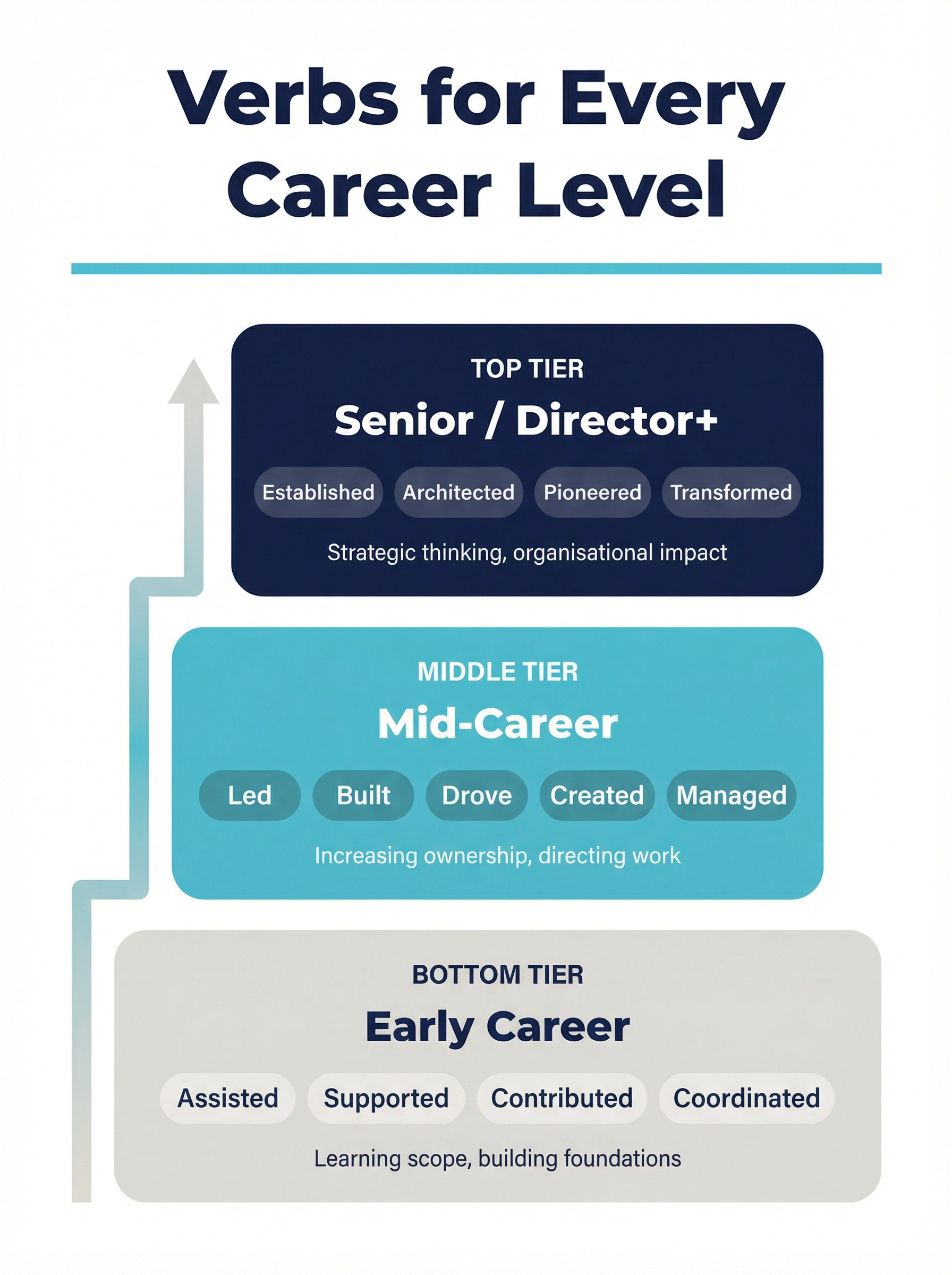
Early in your career, verbs like "assisted," "supported," and "contributed to" are appropriate. You weren't driving strategy. You were learning. Use verbs that honestly reflect that scope.
As you move into mid-career roles, your verbs should show increasing ownership. "Led," "built," "drove," "created." These are the right verbs when you're directing work, not executing it.
At director level and above, your verbs should imply strategic thinking and organisational impact. "Established," "architected," "pioneered," "transformed." These suggest you're operating at a level where your decisions shape company direction, not just department operations.
And that matters because your verb choices send a message about where you see yourself professionally. If you're targeting a leadership promotion, your verbs should already reflect leadership capability. If you're staying in an individual contributor role, different verbs are appropriate. And that's not about inflating your resume - it's about accurately representing the scope of work you're doing.
I see a few patterns that hurt candidates' chances:
Overusing absolute verbs without evidence. "Transformed the organisation" is a massive claim. If you're a mid-level employee at a 500-person company, you probably didn't transform anything. "Transformed processes in my department" is different. Be honest about scope.
Using powerful verbs to describe passive work. "Pioneered a new software system" sounds impressive until I realise you just implemented something your vendor sold you. "Implemented enterprise software platform" is accurate. Save "pioneered" for when you actually created something new.
Listing verbs without showing outcomes. "Optimised marketing processes" means nothing without results. "Optimised marketing processes, reducing cost per acquisition by 22% while improving conversion rate by 18%" tells me what you did and why it mattered.
Clichés that lose all meaning. "Results-driven professional." "Team player." "Dynamic leader." These phrases appear on thousands of resumes and register as nothing. Show results instead of claiming them. Demonstrate teamwork through specific collaboration examples. Lead with actual leadership stories.
What I've noticed is that candidates often choose big words when what they actually need is precision. A specific, accurate verb beats an impressive-sounding vague one every time.
Your Career Profile - the two to four sentence opening section at the top of your resume - should use strong verbs to establish your professional identity immediately.
Compare these:
Weak: "Experienced operations manager with proven leadership abilities and strong problem-solving skills."
Strong: "Operations director who built and scaled logistics operations supporting $180M in annual revenue, reducing supply chain costs by 19% while improving on-time delivery to 97.3%."
The second version uses verbs ("built," "scaled," "reducing," "improving") that immediately establish who you are and what you deliver. It uses specific numbers that demonstrate credibility.
Your Career Profile needs to set up everything that follows. Read our article on how to write a resume summary for detailed guidance on this section.
Here's something important: strong verbs alone don't make a strong resume. The structure matters as much as the language.
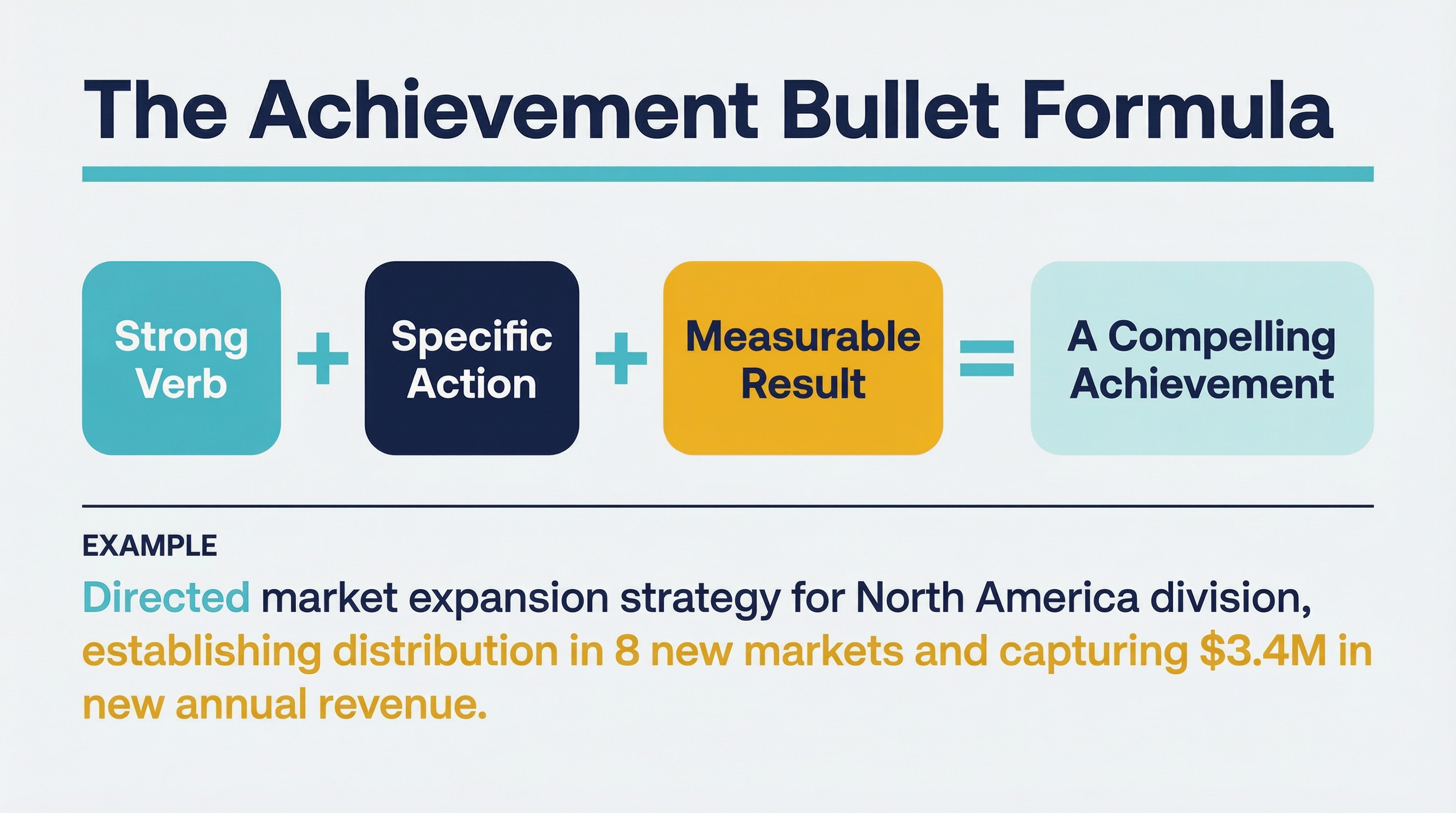
A well-crafted achievement bullet follows this pattern:
Strong verb + specific action + measurable result
"Directed market expansion strategy for North America division, establishing distribution in eight new markets and capturing $3.4M in new annual revenue."
Let's break that down:
Without the verb, it's "market expansion in North America." Vague.
Without the action, it's "directed revenue growth," which could mean anything.
Without the result, it's "directed market expansion," which could have failed.
Together, they tell a complete story.
This is why I've always emphasised that resumes aren't about skills or years of experience. They're about what changed because of you. And that change needs to be specific and measurable.
When you're stuck on how to phrase a bullet point, ask yourself: what was different after I did this? If you can't answer that question, you don't have a strong bullet yet. Go back and figure out what actually shifted - revenue, cost, time, quality, capability - and put that in the bullet.
I'm going to give you a more complete breakdown of high-impact verbs organised by category. Use this as a reference when you're rewriting your resume. But don't just pick the most impressive-sounding verb. Pick the one that's actually true for your work.
Leadership and Strategic Direction: Directed, Orchestrated, Spearheaded, Championed, Pioneered, Steered, Established, Instituted, Architected, Structured, Founded, Launched, Initiated
Team Building and Development: Built, Scaled, Recruited, Developed, Mentored, Coached, Cultivated, Trained, Empowered, Retained, Elevated, Promoted, Guided
Project and Program Management: Managed, Coordinated, Executed, Implemented, Delivered, Completed, Oversaw, Administered, Facilitated, Organised, Orchestrated, Prioritised, Scheduled
Growth and Expansion: Grew, Scaled, Expanded, Increased, Accelerated, Captured, Won, Penetrated, Extended, Built, Launched, Diversified
Efficiency and Optimization: Optimised, Streamlined, Automated, Reduced, Eliminated, Improved, Enhanced, Refined, Simplified, Accelerated, Consolidated, Integrated
Analysis and Investigation: Analysed, Assessed, Investigated, Diagnosed, Evaluated, Identified, Audited, Measured, Quantified, Researched, Examined, Tested, Validated
Communication and Influence: Presented, Articulated, Advocated, Influenced, Negotiated, Persuaded, Convinced, Documented, Authored, Communicated, Reported, Briefed, Collaborated
Innovation and Creation: Created, Designed, Developed, Invented, Conceptualised, Engineered, Architected, Formulated, Produced, Crafted, Devised
Problem-Solving: Resolved, Troubleshot, Remediated, Corrected, Addressed, Mitigated, Prevented, Eliminated, Fixed, Solved
Before you finalize your resume, run through these checks:
Do your verbs match your actual role? If you supervised others, don't claim you "directed strategy." If you contributed ideas, don't say you "established" something.
Is each verb paired with a specific outcome? Every major achievement should show impact - numbers, time saved, improvements, growth.
Are you using the same verb repeatedly? Read through and highlight your opening words. If the same verb appears more than once or twice in the whole resume, add variation.
Do your verbs align with your target role's language? If the job posting emphasises "driving growth," is that language in your resume? If it emphasises "building relationships," do your bullets show that?
Would the same resume work for different jobs? If yes, your bullets are probably too generic. Tailor them to emphasise the aspects that matter most to each target employer. We have a complete guide to tailoring your resume for each job.
Strong action verbs matter because they clarify. They establish your agency. They demonstrate that you didn't just attend events - you drove outcomes. And that signals to me that you can deliver results in the next role too.
But verbs are just the start. The real value comes when you pair strong language with specific outcomes and honest scope. "Spearheaded a transformational initiative" means nothing. "Spearheaded initiative to consolidate three legacy systems into one unified platform, reducing IT maintenance costs by 26% and reducing average system downtime from 8.3 hours quarterly to 0.2 hours quarterly" tells me something real.
That's the difference between a better-sounding resume and a better resume. One makes you sound more impressive. The other makes me believe you can do the work.
When you're rewriting your resume with stronger verbs, the goal isn't to impress me with vocabulary. It's to be clear about what you contributed and what changed because of you. The right verb helps. But the evidence is what sells.
Most candidates make the same five mistakes that get resumes rejected in seconds. Find out what they are.