
finding a job
cover letter

When I'm screening resumes, I spend maybe six seconds on the first pass. In that time, I'm looking at three things: your name, your title, and that opening section. Most people call it a professional summary. I call it a Career Profile. And if you get it right, it's the difference between me reading your whole resume or moving on.
The truth is that most career profiles I see are forgettable. They sound like they were generated by the same algorithm. "Results-driven professional with extensive experience in..." I see it dozens of times a week. It doesn't tell me who you are. It doesn't tell me what you actually do or what kind of environments you've worked in. And it definitely doesn't tell me why I should care.
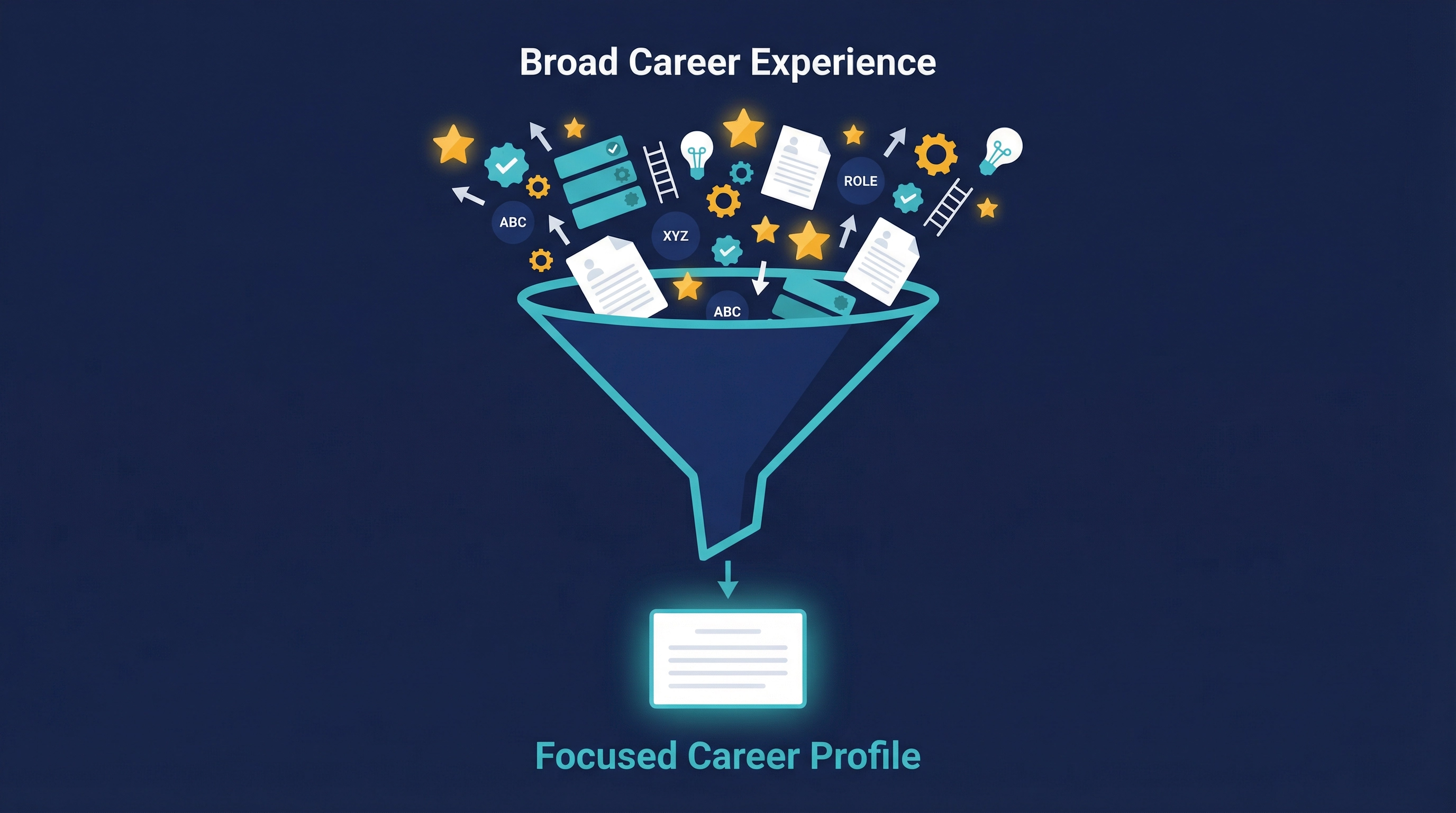
Let me be clear about what I'm talking about here. A Career Profile is a two to four sentence positioning statement that sits at the top of your resume. It's not your career objective. It's not your life story. It's a concise statement that answers one central question: who are you professionally, and what kind of value do you bring?
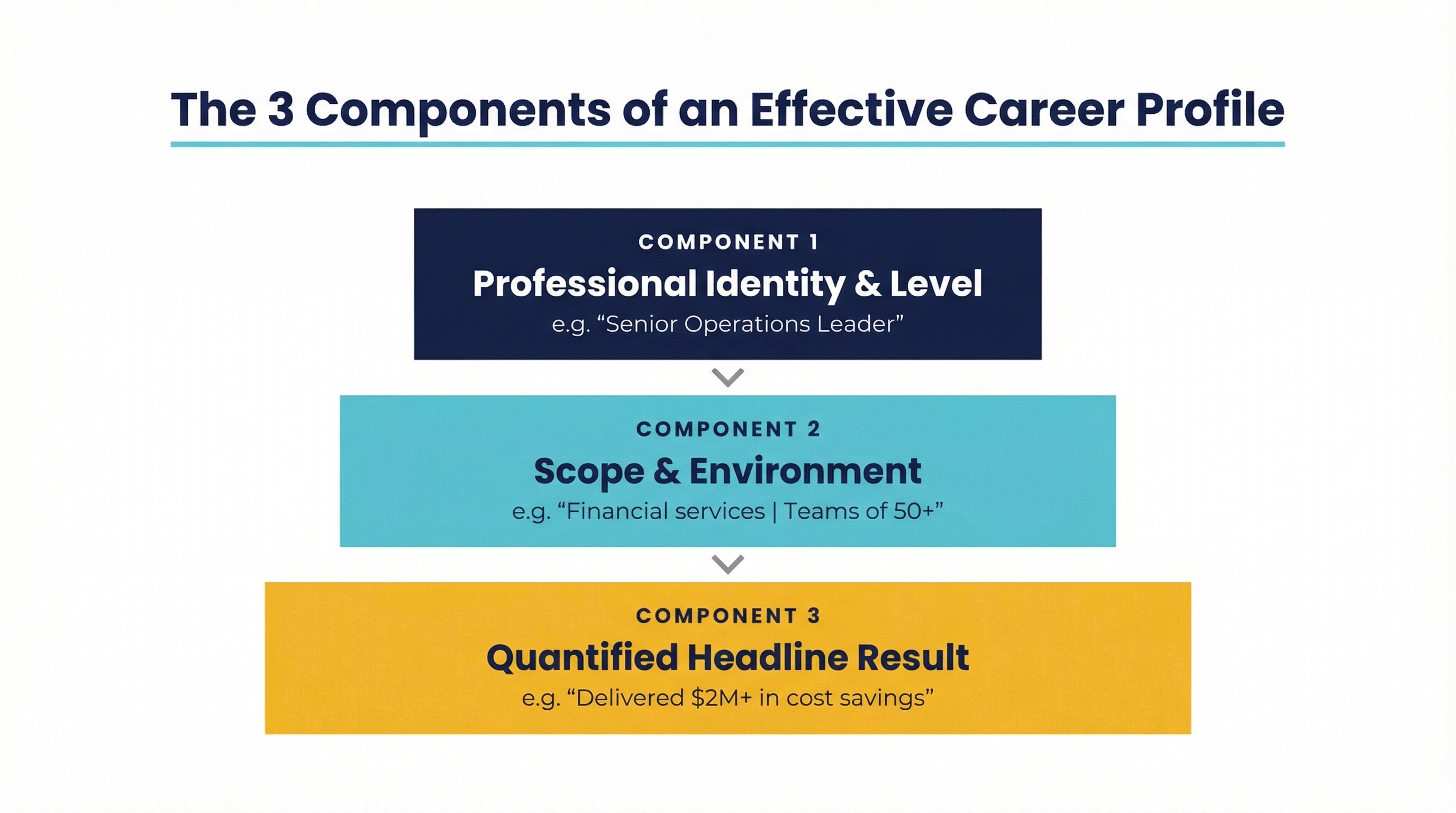
When done right, this section establishes three things. First, it tells me who you are and what you do. Second, it gives me a sense of the kinds of environments and scales you've worked in. Third, it includes at least one concrete result or metric that demonstrates your impact. All of that should fit comfortably into three lines, maybe four at the absolute maximum.
What I've noticed is that most people underestimate how much weight this section carries. They think the Career Profile is just throat-clearing before you get to the real substance of your experience. But here's what actually happens: if your opening section doesn't land, I'm less likely to read the rest of your resume carefully. I'm scanning, not reading. And that means missed opportunity on your end.
The reality is that your Career Profile is the section that gets read in full on the first pass. Everything else? I'm looking for evidence that backs up what you claimed up here. So you need to make those first sentences count.
There's research that explains why this works. Interview studies show that pre-interview impressions predict outcomes as strongly as the interview content itself — and those impressions form within seconds [1]. Your Career Profile is where that pre-interview impression gets built. And a 2024 study on resume screening found that when reviewers process information in segments, impressions formed from the first few snippets diverge — but converge toward accuracy as more information is processed [2]. What this means is that your Career Profile sets the frame through which everything else on your resume gets interpreted. A strong opening primes the reader to see your experience favourably. A weak one does the opposite.
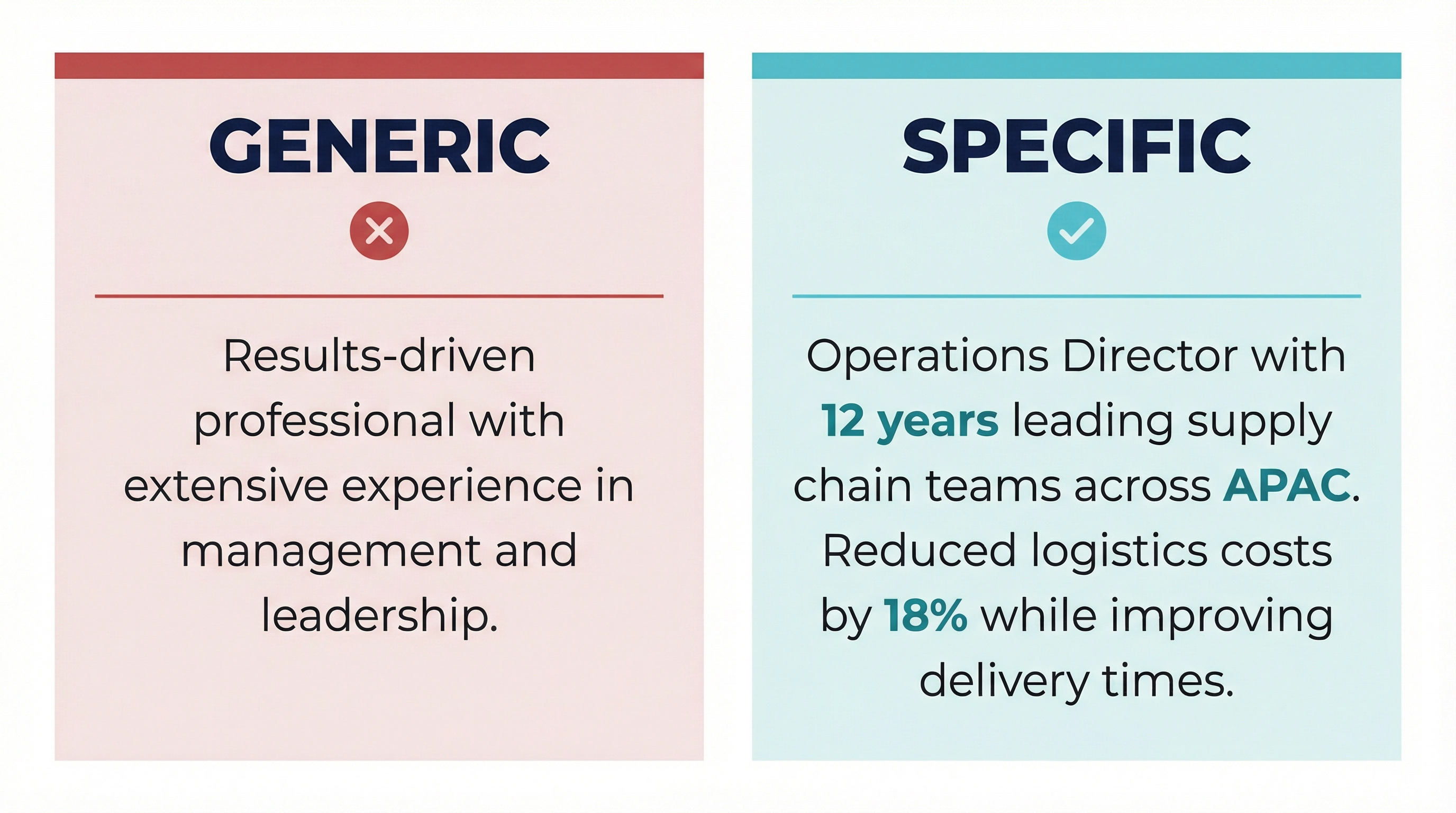
Let's talk about what doesn't work, because I see it constantly. A generic Career Profile reads like it could belong to anyone in your field. "Experienced marketing manager with a track record of successful campaigns and strong leadership skills." Swap out "marketing" and you've got a template that could describe dozens of people.
The problem with that approach is that it doesn't differentiate you. Part of the reason for that is that it doesn't actually tell me anything specific about how you work or what you bring to the table. It's all adjectives and no substance. "Strong leadership skills" tells me nothing. "Managed teams of 8-12 people across three product launches" tells me something.
This is where a lot of people go wrong. They think broader language is safer — like if they cast a wider net, they're more likely to appeal to different hiring managers. What I've noticed is that the opposite is actually true. Specificity is what makes you memorable. It's also what makes you credible.
When your Career Profile could describe anyone in your field, it's too generic. And the risk you're running is that I assume you're generic too.
Here's how I approach it when I'm helping someone get this section right. Start by thinking about who you are professionally and what kind of environments you thrive in. Not what sounds impressive. What's actually true about how you work and what you've accomplished.
Let's say you're a sales manager. Instead of "Results-driven sales leader with 12 years of experience," try this: "Built and scaled high-performing sales teams from startup to market leader, driving 40% annual growth while maintaining 90%+ team retention across B2B SaaS."
See what happens there? That second version tells me you've worked in SaaS. It tells me you've managed team growth as the company scaled. It tells me you've driven significant revenue growth. And it tells me something that matters a lot to me as a recruiter: your teams actually stick around. That specificity is what separates a senior resume from a generic one.
What this means is that you've moved from abstract to concrete. You've given me the evidence I actually need to understand if you're worth talking to.
Here's another example. "Experienced operations manager" becomes "Transformed operational efficiency in a 500+ person manufacturing environment, reducing production costs by 18% and cutting order fulfilment time from 8 days to 3."
Notice what's different. The second one establishes scale — you've worked in a real-sized organisation. It shows impact — cost reduction and speed improvement. And those numbers are specific enough that they feel credible. Not "significantly reduced costs," but 18%.
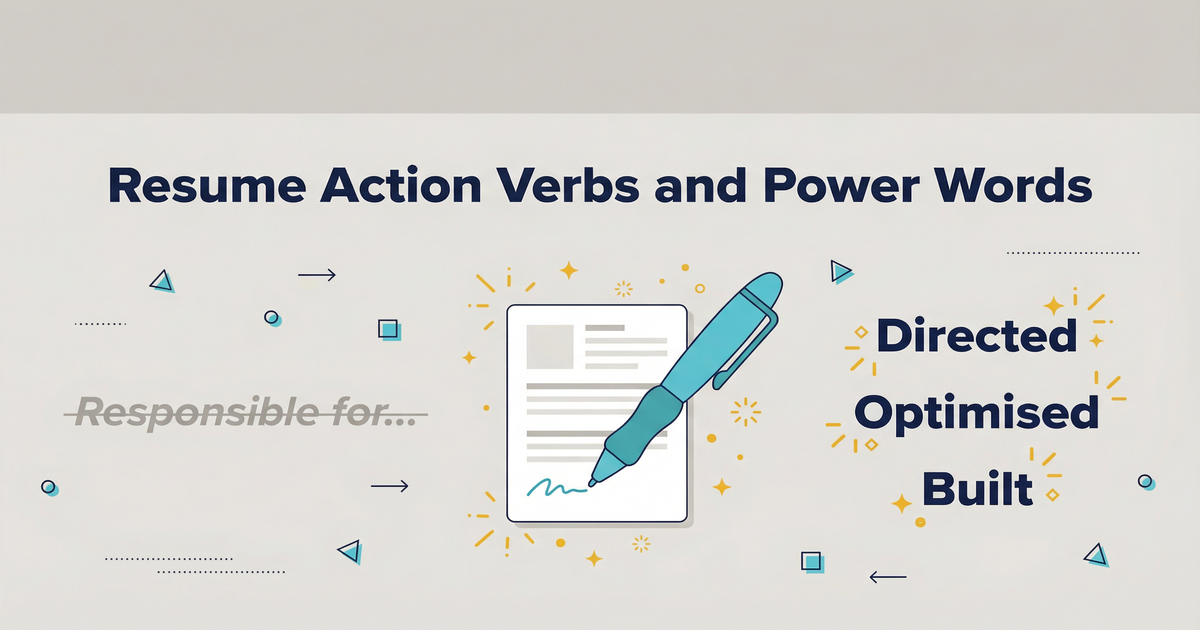
The language you use matters more than people realise. Avoid passive constructions like "responsible for" or "involved in." Those phrases distance you from your work. They make it sound like you were there, but maybe didn't really do the thing.
Instead, lead with strong verbs. "Launched," "built," "scaled," "transformed," "restructured," "drove," "established." These indicate action and ownership. And that matters because I'm trying to get a sense of what you actually did, not just what happened around you.
The numbers matter too. Not because I'm obsessed with metrics, but because numbers are harder to fake. Anyone can say they "improved efficiency." Saying you improved it by 18% while cutting five days off the timeline — that's a claim I can evaluate. And that specificity makes me believe you've actually done the work you're describing.
What I've noticed is that people often leave numbers out because they think the figure isn't impressive enough. But a real 12% improvement is more credible than a "significant" improvement. The specificity itself is what builds credibility.
That said, pick the metrics that actually matter in your field and in your role. A product manager might lead with adoption numbers or user growth. A project manager might lead with on-time delivery rates or budget management. An accountant might lead with audit improvements or compliance records. The number should reflect what success actually looked like in your job.
I want to push back on something that's still surprisingly common. Some people still use what they call an "objective statement." "Seeking a position in marketing where I can leverage my skills and grow my career."
That's not helpful. You're telling me what you want, not what you bring. And what I care about is what you bring.
Your Career Profile is a positioning statement, not a job objective. It's saying: "This is who I am professionally, and here's what I deliver." It's not saying "I want this job." It's saying "I'm the kind of person who does this work, at this scale, with these results."
The distinction matters because a recruiter is trying to figure out if you're a fit for the role they're filling. They don't need to know that you want to grow your career. Everyone wants to grow their career. What they need to know is whether you have the specific experience and the capability to do the job well.
The structure I'm describing works across almost every field, but the content obviously shifts. An engineer's Career Profile looks different from a designer's or a financial analyst's. The principle stays the same — specificity, scale, and at least one quantified result — but the application varies.
A software engineer might write: "Full-stack engineer who led the architecture and deployment of a microservices infrastructure supporting 2M+ daily active users, improving API response time by 40% and reducing deployment time from four hours to fifteen minutes."
A financial analyst: "Financial analyst who built and maintained forecasting models for a $500M+ revenue division, delivering quarterly forecasts with 94% accuracy and identifying $3.2M in operational cost savings."
An operations director: "Operations director with ten years optimising supply chain and distribution for consumer goods companies. Reduced logistics costs by 23% across three distribution centres while improving on-time delivery from 91% to 98.5%."
What these have in common is that they're not trying to be everything. They're anchored in what you actually did and the environment where you did it. They're specific to the kind of work and the kind of scale.
The reality is that once you understand the structure, you can apply it to your own situation. The hard part isn't the format. The hard part is being honest about what you actually accomplished and resisting the urge to over-claim.
One thing I want to emphasise: your Career Profile should set up everything that follows. In my recommended resume format, the structure is Career Profile, then Core Capabilities, then Career Summary, then Education, then Detailed Career History.
The Career Profile makes a claim about who you are. The Core Capabilities section backs that up with three key areas and evidence for each. The Career Summary gives a brief narrative of your trajectory. The Detailed Career History shows the specifics.
What this means is that if you say in your Career Profile that you've built high-performing teams, I should see evidence of that in your Core Capabilities. I should see the team sizes and outcomes in your detailed job descriptions. A lot of people make the mistake of putting something in their Career Profile and then never mentioning it again. That's a disconnect. Your resume should feel like one coherent document where the opening section sets up the supporting evidence.
There's a question that comes up a lot: should your Career Profile stay the same, or should you adjust it for each application?
The truth is that you'll want some consistency — your core identity shouldn't change from application to application. But what I've noticed is that you can emphasise different aspects of your experience depending on what the role calls for.
Let's say you're a software engineer who's worked on both backend infrastructure and customer-facing features. Your Career Profile might lead with infrastructure if you're applying for a backend role, but lead with user impact if you're applying for a product engineering role. The core facts are the same. The emphasis shifts.
For guidance on how to approach this across your whole resume, check out our article on how to tailor your resume for each job. The same principles apply to your Career Profile.
I want to flag a few things I see regularly that could actually hurt your candidacy.
First: overstating your scope. If you were part of a project that achieved something significant, don't claim credit for the whole thing. "Led" and "contributed to" are different claims. I can usually tell the difference, and if I spot you overstating, I'll read everything else on your resume more sceptically.
Second: using buzzwords without backing them up. "Strategic thinker" means nothing to me without evidence. "Drove transformation" means nothing without describing what actually changed and by how much.
Third: being too modest. I understand the instinct not to sound arrogant, but this is your resume. You're allowed to own your accomplishments here. The difference between "helped implement a new system" and "implemented a new system that reduced processing time by six weeks" is just accuracy, not arrogance.
For more on mistakes to watch for, take a look at our piece on resume mistakes to avoid.
Here's the process I'd recommend. Write your Career Profile, then read it aloud. Does it sound like you? Or does it sound like a template? If it sounds templated, rewrite it until it doesn't.
Then ask yourself: could this describe someone else in my field? If yes, add specificity. Add the number. Add the context. Make it harder to swap your name for someone else's.
Finally, check it against the rest of your resume. Does it set up what follows? Does the evidence match the claim? If there's a gap, either adjust the profile or make sure the rest of your resume backs it up.
Your Career Profile is the opening argument on your resume. It's where you establish who you are and why someone should keep reading. Get it right, and you've moved yourself up the consideration stack. Get it wrong, and you're one of dozens of forgettable applications.
The good news is that it's fixable. It's only three or four sentences. That's a manageable piece to refine until it's sharp.
Your Career Profile is where hiring managers decide whether to read the rest. It's also where most candidates make mistakes that cost them interviews.
[1] First impressions research synthesised from interview meta-analyses: Dipboye & Jackson (1999) documented that initial impressions form within seconds, bias subsequent information processing, and predict outcomes as strongly as interview content. See also: hiring decisions shown to be made within 4-10 minutes of interview start.
[2] Sachs, N.M., Homan, A.C., & Lancee, B. (2024). Impression formation of majority and minority applicants during resume screening. Journal of Applied Social Psychology. N=402 participants. Found impressions diverge after 3rd information segment but converge after 4th and 5th segments.