
finding a job
cover letter


There's a particular kind of panic that sets in when people learn about Applicant Tracking Systems. Someone mentions that their resume might never reach human eyes. Someone else talks about ATS scoring. And suddenly experienced professionals start rewriting their resumes like they're submitting code to a compiler, stripping out formatting, stuffing keywords into every blank space, obsessing over word choice in ways that have nothing to do with actually describing their work.
I get why it happens. The idea that a robot decides whether you move forward is unsettling. The reality is different, and more encouraging than most people think.
Here's what I've seen from the recruiter side over sixteen years: yes, ATS systems exist and yes, they filter applications. But most of what people worry about with ATS is either outdated or based on misunderstanding how recruiters actually use these systems. The good news is that what genuinely helps with ATS, and more importantly, with getting hired, is simpler and more straightforward than the mythology suggests.
Let me start with something important: Applicant Tracking Systems are real, they do parse resumes, and if you write a resume that's genuinely difficult to read, that could work against you. But most people's concern about ATS isn't really about readability. It's about a phantom scoring system that supposedly decides their fate before a human ever looks.
The truth is that ATS scoring is far less sophisticated than people imagine. These systems can identify keywords and flag basic match percentages, but they do so without understanding context or nuance. I've reviewed thousands of candidates, and I can tell you with certainty that some of my best hires came from profiles with low ATS match scores. Why? Because their experience didn't fit neatly into the keyword terms the hiring manager searched for, though they were exactly the right person for the role.
What I've noticed is that the scoring mechanism cherry-picks terminology without understanding what that terminology actually means in context. A candidate who spent three years in project-heavy work but titled it "programme delivery" instead of "project management" could score lower than someone who parrots the phrase without the depth. The system cannot tell the difference. It just counts matches.
Here's what matters more: recruiters still look at the full applicant pool. We don't just look at the top-ranked candidates from the ATS and ignore everyone else. The ATS is an organisational tool - it helps us manage volume and search by criteria - but it's not a reliable filter for quality. You've probably seen the statistic that ATS systems automatically reject 75% of resumes. That figure traces back to a company called Preptel - a resume services company that shut down in 2013 and never published its methodology or data.1 No peer-reviewed research has ever supported that number. More recent survey data from SHRM found that 92% of recruiters confirmed their ATS does not auto-reject based on resume content alone - it sorts and ranks.1 So if you're worried that a low score means you're automatically eliminated, that's not actually how it works in practice.
The real risk isn't failing some hidden ATS algorithm. It's writing a resume that's genuinely hard to parse or read. And that's a much more solvable problem than the mythology suggests.
This is where we need to separate the real function of keywords from the fear-based narrative around them.
Keywords matter, but not for the reason people usually think. They do not matter because some black-box algorithm is grading your resume. They matter because recruiters search using those terms. When someone on the hiring team opens the ATS and searches for "Salesforce CRM implementation" or "supply chain optimisation," they're looking for candidates who've used that language. If your resume contains those exact terms alongside evidence of the work, you show up in that search. That's it.
What this means in practice is straightforward: keywords matter for discoverability, not for secret scoring. And the way to ensure discoverability is to describe your actual experience using the language your target employers use when they talk about that work.
This is why reading job descriptions carefully matters so much. A job posting for a "Client Success Manager" might list responsibilities that match exactly what you did as an "Account Executive." The company is searching for those words. Client Success Manager. If your resume says Account Executive only, you won't appear in that search even if you're a perfect fit. That is not ATS magic, that is basic search functionality.
We're also seeing that the language varies by industry and company size. One company talks about "stakeholder engagement," another about "relationship management." One uses "FP&A," another says "financial planning and analysis." Your job is to map your actual experience to the vocabulary your target companies use. That's the keyword strategy that works.
The most effective keyword research you can do is free and already exists: the job descriptions you're actually targeting.
Start by collecting five to ten job postings for the type of role you're pursuing. They don't all have to be at the same company level or industry, though similar roles help most. Copy the text from each posting into a word cloud generator (there are several free ones online). The terms that appear largest are the ones appearing most frequently across all those descriptions. Those are the terms your target market is using.
Pay close attention to how different companies phrase the same responsibility. One posting says "managed P&L." Another says "owned budget." Another says "led financial planning." All three are describing similar work, but they use different language. Identify which phrases appear most commonly and weave those into your resume where they accurately describe your work.
What I've noticed is that variations in terminology are often more important than people realize. You might have been in a role that was essentially project management, but the hiring manager might search for "programme delivery" or "initiatives management" instead. If your resume never uses those terms, you will not appear when they search, even though you're doing exactly the work they need.
The practical approach is to maintain a list of five to seven core phrases that describe your primary area of expertise, drawn from your actual target job descriptions. These should be terms you can genuinely support with examples in your experience section. If you don't actually have that experience, don't include the keyword. Getting past initial screening only to fail the interview because you oversold your capabilities wastes everyone's time.
Position matters when it comes to keywords, but not for the mystical reasons people often imagine. It matters because both ATS systems and human recruiters read from top down, and they don't always read the entire document.
Your Career Profile or professional summary sits at the very top. This section should include your most important keywords naturally, not because some algorithm is weighting them differently, but because this is the section most likely to actually get read in full. A strong summary accomplishes two things. It immediately positions your professional level, and it includes the key terms that describe what you do.
Weak version: "Experienced manager seeking new opportunities where I can apply my skills in a fast-paced environment."
Stronger version: "Finance Director with 14 years driving FP&A, treasury operations, and investor relations for public companies. Background includes M&A integration, SEC reporting, and ERP implementations across Oracle and SAP platforms."
The second version tells someone immediately what you do, at what level, and with what tools. Someone scanning that paragraph for thirty seconds knows exactly who you are. And it happens to be keyword-rich because you're accurately describing your actual experience.
Your detailed experience section carries the most weight because it contains the substance that hiring managers want to evaluate. Keywords should appear here naturally as part of describing your achievements, not as an artificial addition. "Led the implementation of a CRM system that improved sales conversion by 18%" contains searchable terms. CRM, implementation, sales conversion. While also demonstrating actual impact.
Part of the reason keyword placement matters is that recency tends to be more visible. If you're searching for someone with a particular skill, you probably care most about recent experience with that skill. Make sure your most relevant and recent roles contain your most important terminology. Earlier career history can be less specific.
Here's the thing about keyword optimisation that people often miss: the best keyword strategy is simply describing your genuine experience accurately using industry-standard language.
You do not need to stuff uncommon terms throughout your resume. You do not need to repeat the same phrase five times to rank higher. What you need is to describe your work using the words that your industry and your target companies use. That is all. When you do that, the keywords are there because they're accurate, not because you're gaming a system.
This is why I emphasise achievement-focused bullet points over responsibility lists. When you describe what you accomplished and what changed because of your work, you naturally include the terminology that matters.
Responsibility-focused (weak): "Responsible for optimising supply chain operations and reducing costs."
Achievement-focused (strong): "Redesigned supplier evaluation process and consolidated vendor base from 47 to 18 key suppliers, reducing materials costs by 16% annually while improving delivery reliability from 89% to 97%."
The achievement version includes searchable terms. Supply chain, vendor management, cost reduction, delivery reliability. Because you're describing the actual work. You're not forcing the keywords in; they're there because they're part of what you genuinely did.
What I have found over thousands of resume reviews is that the resumes that perform best do not feel optimised. They feel clear. The candidate accurately described their relevant experience using language the industry recognises. The keywords are present because the experience is real and well-articulated, not because someone was trying to game a system.
ATS anxiety tends to focus on formatting decisions, and some of that concern is overblown. But there are legitimate technical foundations that help both ATS parsing and human readability.
Use standard section headers: "Experience," "Professional Experience," "Education," "Skills." Creative headers like "My Career Journey" or "Technical Arsenal" do not break ATS systems anymore, but they do add unnecessary friction when a recruiter is trying to scan quickly. Keep it straightforward.
Avoid placing critical information in headers, footers, or text boxes. These elements sometimes do not parse cleanly, which means contact information or key qualifications could disappear during extraction. Your name, phone number, and email should be in the body text at the top of the document where they will definitely be found.
Submit as a PDF unless the posting specifically asks for something else. PDFs preserve formatting consistency across systems, and most modern ATS systems handle them well. If you do submit in Word format (.docx), use standard fonts like Arial, Calibri, or Times New Roman.
The broader point about columns and colours? Modern ATS systems handle these much better than they did five years ago. A single accent colour, a subtle line between sections, a clean design: these work fine and actually improve readability for humans. What you want to avoid is anything that genuinely confuses the reading order - multi-column layouts where text jumps around, for example. But a professional two-colour design? That's not a problem.
Single-column layout is still your safest bet for clarity. It forces you to think about what information deserves emphasis, and it's easier for both machines and humans to navigate.
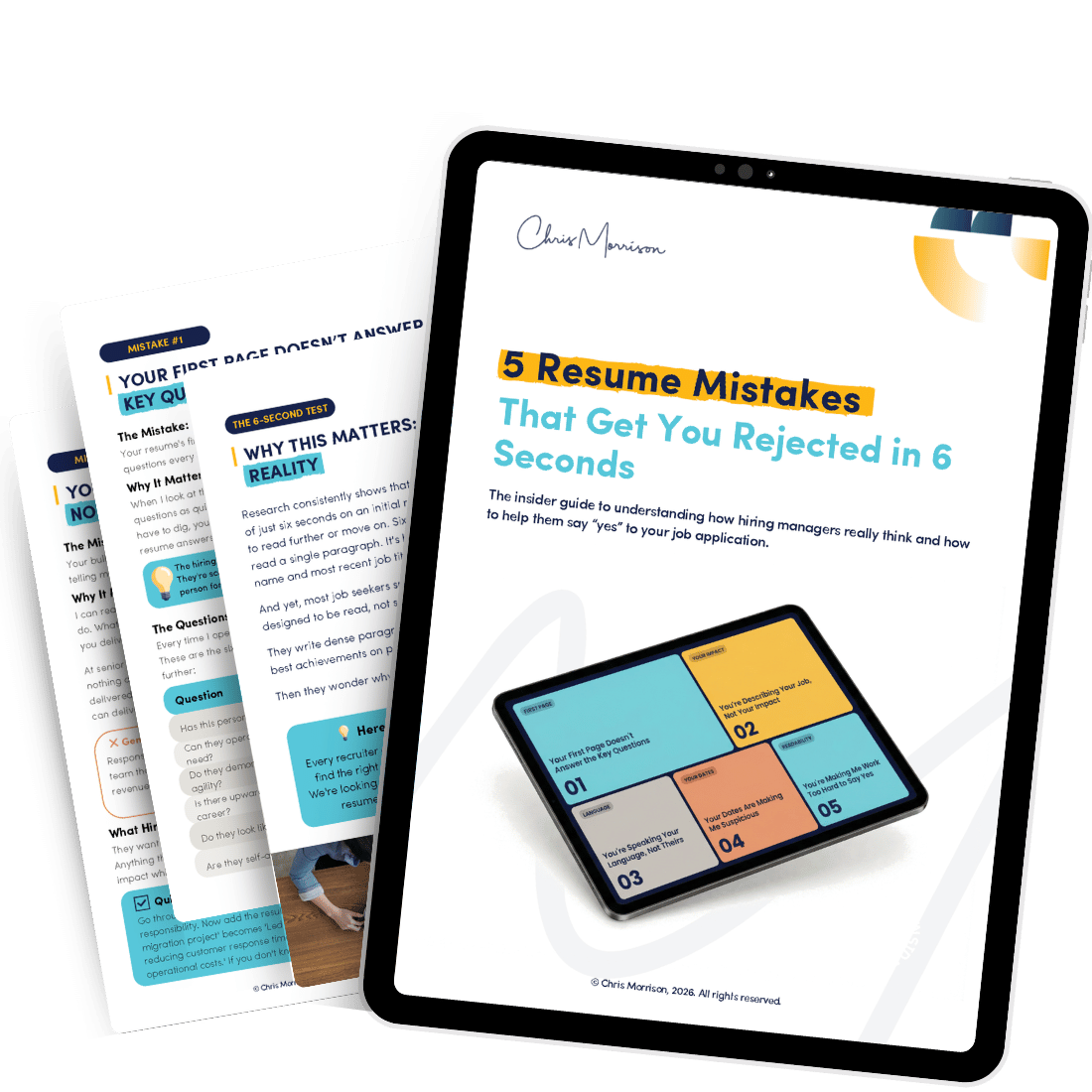
Looking to avoid the most common resume mistakes? Download the free guide: 5 Resume Mistakes That Get You Rejected in 6 Seconds and see what might be holding you back.
Here's where keyword strategy connects to something equally important: tailoring your resume for each job.
A well-tailored resume naturally includes the keywords for the specific role you're applying for because you've identified the language that role uses and reflected it in your resume where it applies to your experience. You're not adding irrelevant terms; you're emphasising the aspects of your background that match that specific opportunity.
This is why I recommend the master resume system: maintain a comprehensive source document with all your roles and achievements. Build base versions for each type of role you target. Then make tailored adjustments for each application. Update your summary to emphasise relevant experience. Reorder your achievement bullets to highlight what matters for that specific role. Adjust your skills section.
This should take fifteen to twenty minutes per application, and it dramatically improves your results. And because you're tailoring based on job descriptions, you're naturally including the keywords that specific employer is using and searching for.
The truth is that good tailoring and good keyword placement support each other. When you're describing your relevant experience prominently and accurately in terms that match the job description, you're doing both at the same time.
There's a lot of noise around keyword optimisation that actually works against you.
Do not keyword stuff. Repeating "project management" fifteen times in different contexts does not make you appear more qualified to systems or humans. It makes you appear to be trying to game the system, and it actually hurts readability. Sophisticated ATS systems can flag this pattern. More importantly, a recruiter reading it will notice and will be skeptical about your credibility.
Do not use hidden text tricks. White text on a white background, minuscule font sizes, or text boxes hiding keywords: these are deceptive and easily detected. Recruiters know this trick exists. Many ATS systems flag documents with hidden text. Do not do it.
Do not include keywords you cannot support with evidence. If you do not actually have experience with something, do not add it just because the job description mentions it. You will pass ATS screening only to fail the interview, which wastes everyone's time and damages your reputation.
Do not sacrifice readability for optimisation. A resume that is technically keyword-rich but confusing to read will perform worse than a clear, well-written resume that is slightly less optimised. Because in the end, humans are making the actual decisions.
Here is something I want to be direct about: getting past ATS screening is not your main problem unless you are applying to completely wrong roles.
If you are applying for appropriate positions and your resume never makes it to human review, something is genuinely wrong. Either your resume is badly formatted or poorly written, or you are missing fundamental qualifications. But if you are applying for roles you are actually suited for, you will likely get through.
The real filtering happens with people, not systems. The real reasons candidates do not advance are: they do not interview well. Their experience does not genuinely match what the role needs. There is someone else with more relevant background. They got nervous on a call. The team decided to promote from within. The budget got cut.
What I have noticed is that people often blame ATS when the real issue is interview performance or fundamental fit. If you are getting initial screens but not moving forward, the problem probably is not your resume passing systems. It is what happens after that.
This is why spending weeks optimising keywords while ignoring interview preparation or resume structure is backwards. Get the fundamentals right first. Use industry-standard language because you're accurately describing your work. Then focus your energy on the parts of the hiring process where you can actually move the needle: your interview, your network, your understanding of what the specific employer needs.
Let me reframe this entirely: keywords are not really about ATS at all. They are about communication.
When you use the same language a job posting uses, you are making it easy for a recruiter to connect your experience to their need. You are speaking in their vocabulary. This matters because recruiting is a language matching game. You are not a data scientist; the job asks for a "machine learning engineer." You are not in "customer success"; the job description calls it "account management." When you translate your actual work into their vocabulary, hiring managers see themselves in your resume. When you do not, they have to work to figure out whether you are the right fit.
And that matters because the recruiter who reviews your resume after the ATS processes it is looking for clarity and evidence, not keyword density. They want to understand, quickly and confidently, whether your experience matches their need. Using the language they used in the job description helps them see that match immediately.
The best resume keywords are not stuffed in. They are the natural result of accurately describing your relevant experience using industry-standard terminology. That is the approach that works for both systems and humans, because it is fundamentally honest about what you have done.
While we are talking about automated screening, there is something more important to address than keyword optimisation. Research from the University of Washington tested three large language models used for resume screening across 550+ real resumes and more than three million comparisons. The findings were stark: white-associated names were favoured 85% of the time, female-associated names were favoured only 11% of the time, and Black male-associated names were never favoured over white male-associated names.2
A separate 2025 study found that when humans work alongside biased AI systems, they mirror the AI biases rather than correcting them.3 This "mirror effect" means human-AI collaboration may actually amplify algorithmic bias.
The truth is that the real concern with automated screening is not your formatting or keyword count. It is systemic bias that no amount of keyword optimisation will fix. I mention this because honesty matters: if you are doing everything right and still not hearing back, the problem may not be your resume at all.
Most candidates make the same five mistakes that get resumes rejected in seconds. Find out what they are.
1 The "75% ATS rejection" statistic traces to Preptel, a now-defunct resume services company (closed August 2013) that never published methodology or data. SHRM (2025) survey data (N=2,040 HR professionals) found 92% of recruiters confirmed their ATS does not auto-reject; 94% reported better hiring processes after ATS adoption.
2 Brookings Institution (2024). Gender, race, and intersectional bias in AI resume screening via language model retrieval. University of Washington research testing three LLMs on 550+ real resumes, 3M+ comparisons.
3 Washington University (2025). When humans work alongside biased AI, they mirror the AI's biases rather than correcting them - the "mirror effect."