
finding a job
cover letter

After 16 years of looking at resumes, I've noticed something that might surprise you: we tend to get fixated on the wrong things.
People spend hours agonising over whether their resume fits perfectly into an ATS system, whether they should use columns or colour, whether their summary statement sounds ambitious enough. Meanwhile, they're missing what actually matters — the things that genuinely make a hiring manager put your resume down.
And here's something worth knowing that puts the mistakes in context: research on hiring discrimination has found that identical resumes receive dramatically different callback rates depending on the applicant's name. One landmark study sent nearly 5,000 fictitious resumes to real job openings and found that white-sounding names received 50% more callbacks than equivalent African-American-sounding names [1]. That's a gap no amount of formatting can fix. I mention this not to discourage you, but because it's honest context: some of the most consequential factors in resume screening are systemic, not about your font choice. What you can control is making your value as obvious as possible, which is what the rest of this article covers.
Let me walk you through what I've actually seen hurt candidates, and then I'll address the things people worry about that frankly don't matter nearly as much as they think.
Here's what I notice most often: resumes that read like job descriptions instead of achievement stories.
You'll see something like: "Responsible for managing stakeholder relationships, conducting quarterly reviews, and implementing process improvements." That's fine. That's what a manager does. But it doesn't tell me anything about what you actually accomplished or what changed because of you.
What I'm looking for is the story underneath. What's a specific example? Did those process improvements save time? Money? Did stakeholder relationships directly lead to a deal closing or a partnership forming? What was different after you were there?
The truth is that when you lead with responsibilities, you sound like every other candidate in that role. When you lead with achievements — actual, measurable impacts — you suddenly stand out. I can see what you genuinely contributed, not just what your job title said you should be doing.
Rather than talk about your responsibilities for undertaking complex negotiations, discuss a particular complex negotiation you undertook and what the impact for the organisation was. That specificity is what sticks with me when I'm reading through dozens of applications.
This is worth spending real time on, because it's the difference between a resume that gets filed away and one that makes someone want to have a conversation with you. 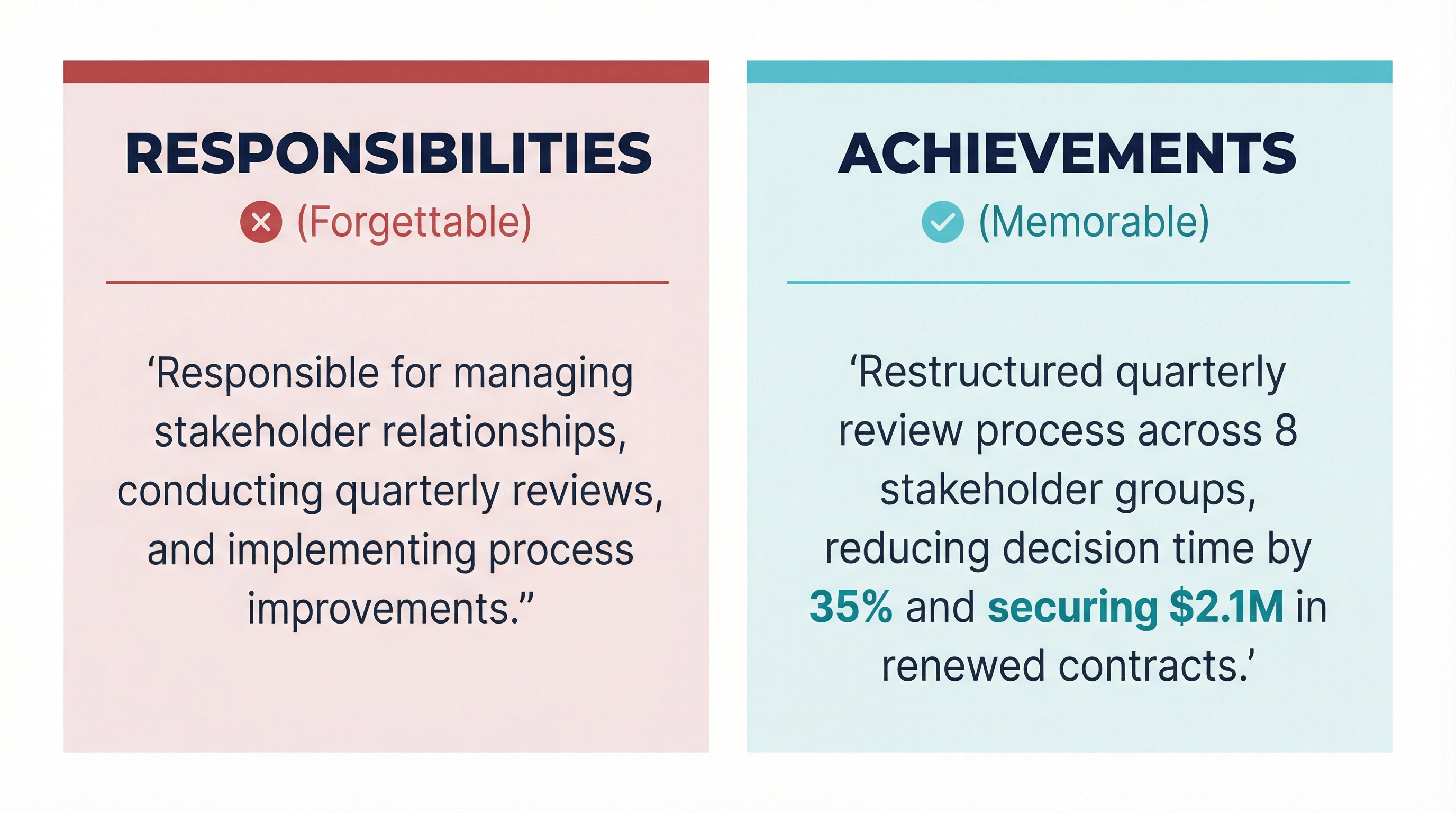 Missing Evidence for Your Core Capabilities
If your resume lists "strategic leadership" as a capability but doesn't include any examples of strategy you've actually led, I'm left assuming you're just using buzzwords.
The structure that works is straightforward: a Core Capabilities section that lists three key strengths, each backed by a specific example from your career. Not just "project management" but "Project management — brought three major software implementations in on time and under budget, with zero critical issues in the first 90 days of use."
What this does is transform a generic resume into one that shows you genuinely have these capabilities. And that matters because anyone can claim to be good at stakeholder management. The evidence is what makes me believe it.
A lot of career summaries read like LinkedIn headline stretches: "Results-driven professional passionate about innovation and excellence, seeking a challenging opportunity to leverage my skills and make an impact."
That could describe anyone. It tells me nothing about you.
What I've noticed is that the strongest career summaries do something different: they tell me who you are, what you've accomplished, and what kind of environments you've worked in. Not in abstract terms, but in specific ones.
You might say something like: "Customer success leader with 12 years in B2B SaaS, specialising in scaling support operations and improving retention metrics. Most recently built a support function from three people to fifteen, reducing ticket resolution time by 40% and improving NPS by 18 points."
That's concrete. I know who you are, what you've done, and what I can expect. For more on getting this right, I've written a detailed guide on how to write a resume summary.
We're also seeing that candidates who think a generic resume works across all applications are substantially limiting themselves.
I'm not talking about changing every word. What I mean is that your resume should be deliberately shaped to match the role you're applying for. If you're applying for a technical leadership role, the first thing I want to see is evidence that you've led technical teams. If you're applying for something more customer-focused, show me customer outcomes.
The structure should help with this. Your Career Profile, your Core Capabilities section, even the order in which you list achievements within each role — these should be chosen with that specific opportunity in mind. You're not being dishonest. You're being strategic about what you emphasise.
What this means is that tailoring is an investment in your candidacy, not a shortcut. The candidates who do this tend to get further. I've covered how to do this effectively in our guide to tailoring your resume for each job.
Here's something that surprises people: the ATS worry is overblown.
I'll be direct. ATS systems can be unpredictable. They cherry-pick keywords, they don't understand context the way a human does, and sometimes a profile that scores low in the system is exactly what I'm looking for. The truth is that recruiters still review the full applicant pool. We see the candidates who score low. We see the candidates who don't match the keywords perfectly.
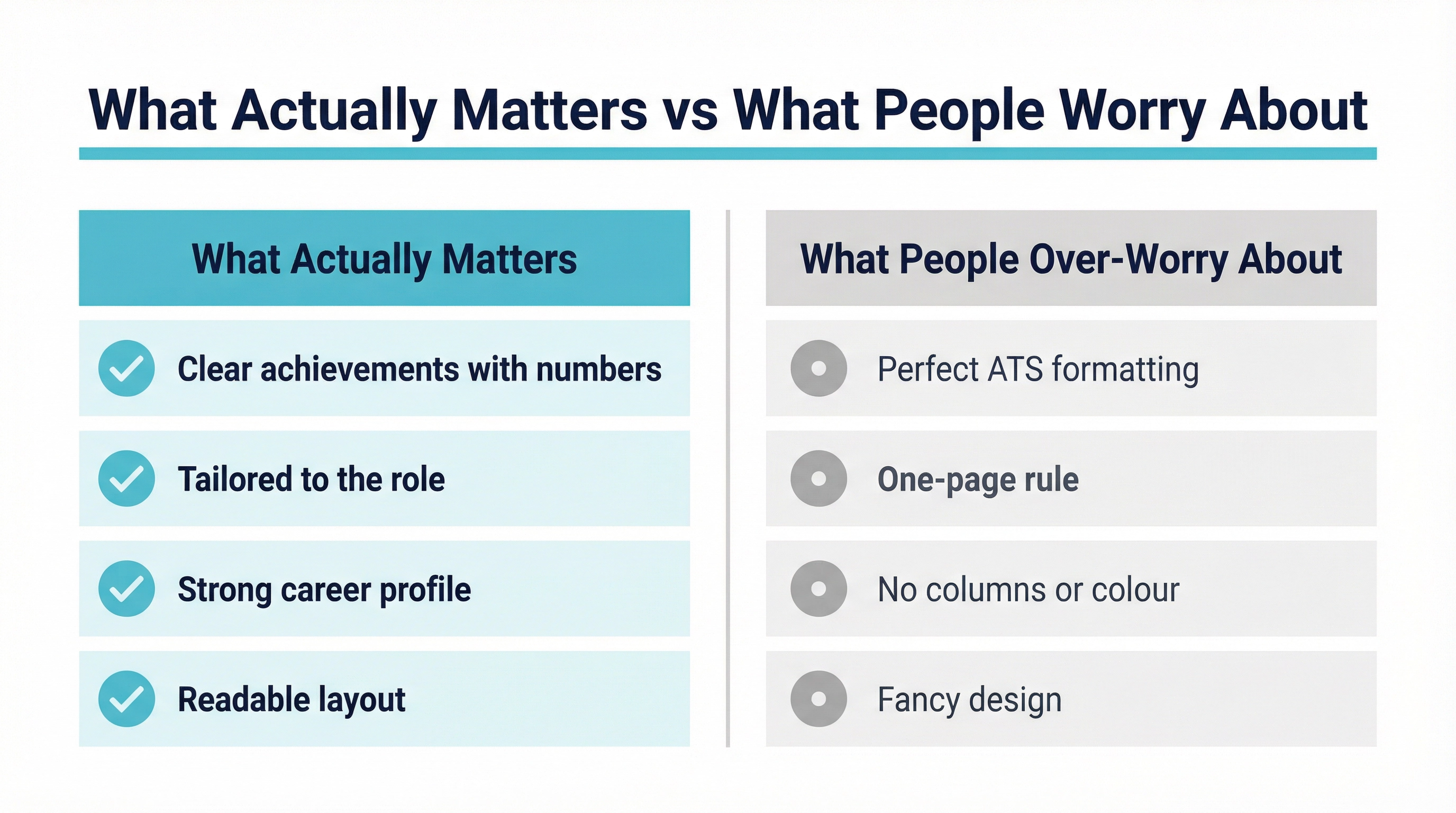
So yes, you should make sure your resume is readable and includes relevant keywords from the job description. That's not complicated — that's just being thoughtful about your application. But the idea that you need to obsess over ATS optimisation, that you need to use specific formatting or structures purely to game a machine? That's where the advice tends to break down.
What I've noticed is that people often sacrifice clarity and readability in the name of ATS optimisation, and that actually works against them. If your resume becomes harder for a human to read, that's worse than any ATS score.
Use clear section headings. Include relevant keywords naturally. Make it easy for a person to scan and understand your story. Do those things, and you're already ahead.
 The Format Question Is Less Critical Than You Think
This is probably the one that gets the most pushback, but I'll say it: columns and colours don't hurt you as much as the internet would suggest.
Modern ATS systems handle these fine. And when I'm looking at a resume, I'm looking at a PDF. If your design is clean and functional, if it helps me move through your story more quickly, that's an advantage.
What does matter is readability. Is the text easy to read? Can I scan the major sections without squinting or getting confused? Is the visual hierarchy helping me understand what's important? Those things absolutely count.
Where I see people trip up is when they prioritise aesthetic over substance. Beautiful design that makes the resume harder to scan, or that relegates your achievements to small text while a skills visualisation takes up half the page — that's when design hurts you. The truth is that format matters only insofar as it serves your content. If you want more detail on what works, check out our article on resume format best practices.
There's a rule that resumes must be one page. I find that rule unhelpful for most of the professionals I work with.
If you're early in your career, one page makes sense. You don't have a decade of experience to show. If you're mid-career or beyond, a single page often forces you to cut important information. And that matters because recruiters need enough detail to understand what you actually did, not just your job titles.
What this means is that the length should be driven by what's actually important, not by an arbitrary rule. For the last ten years of your career, I want detail. I want to understand what you did, why it mattered, what changed. Earlier roles? Less detail. Early career? Maybe you summarise or combine them.
The thing I've noticed is that candidates often try to cram everything onto one page, which means achievements end up as bullet points with no context. Compare that to a two-page resume where you can actually explain the impact, and the two-page version wins every time.
When I see resumes full of words like "led," "drove," "spearheaded" without any actual detail, I know the candidate hasn't thought carefully about the story they're telling.
Use strong verbs, absolutely. That's essential. But pair them with specifics. "Spearheaded an initiative to improve customer retention" tells me nothing. "Identified that customer churn was highest in Q3 due to delayed onboarding, restructured the process, and reduced churn by 23%" tells me everything.
And that matters because specifics are what make you memorable. They're what make a hiring manager sit up and take notice. They're what separate a candidate who's clearly capable from one who's just using the right vocabulary.
Part of the reason gaps in employment matter is that they're going to come up in a conversation anyway. Rather than leave a recruiter wondering or assuming the worst, it's better to address them thoughtfully.
You don't need a lengthy explanation. You don't need to apologise. But if there's a six-month gap, acknowledge it. Were you dealing with something personal? Taking time to rethink your direction? Completing a course or certification? A sentence or two is enough. It shows you're aware of the gap and that you can talk about it directly.
What I've seen hurt candidates is the absence of any acknowledgement, combined with a vague effort to hide the gap through formatting tricks. That raises more questions than it answers.
I notice that some candidates in their 40s, 50s, or beyond seem to be using the exact resume format and approach they used 20 years ago. And that can work against them.
Not because age matters — it shouldn't, and I'm not making decisions based on age. But because outdated resume formats can sometimes signal things you don't intend. And more importantly, they often fail to emphasise the most relevant recent work.
The reality is that your last ten years matters far more than what you did in your first five or ten years. Most candidates over-weight their earlier roles and under-weight recent experience. That's a mistake worth correcting.
Your resume should reflect where you are now, not where you were. That means current formatting, recent achievements emphasised strongly, and older roles handled more briefly.
One typo won't disqualify you, but multiple errors signal carelessness, particularly for roles involving written communication or attention to detail.
Spellcheck catches obvious errors but misses context problems: "manger" instead of "manager," words spelled correctly but used in the wrong place. Read your resume aloud. Have someone else read it. Print it and check the physical copy, because errors often jump out more on paper than on screen.
Pay particular attention to company names, software titles, and industry terminology. Misspelling a previous employer's name or a technical tool you say you know undermines your credibility faster than almost anything else.
At the end of all this, the question that matters most is simple: does your resume effectively tell the story of what you've accomplished and what you can contribute?
If it does, you're probably fine with the formatting. The colours probably aren't hurting you. The ATS probably isn't holding you back as much as you think. What matters is that a recruiter picks up your resume and sees someone who's accomplished real things and can articulate them clearly.
Focus there. Everything else is secondary.
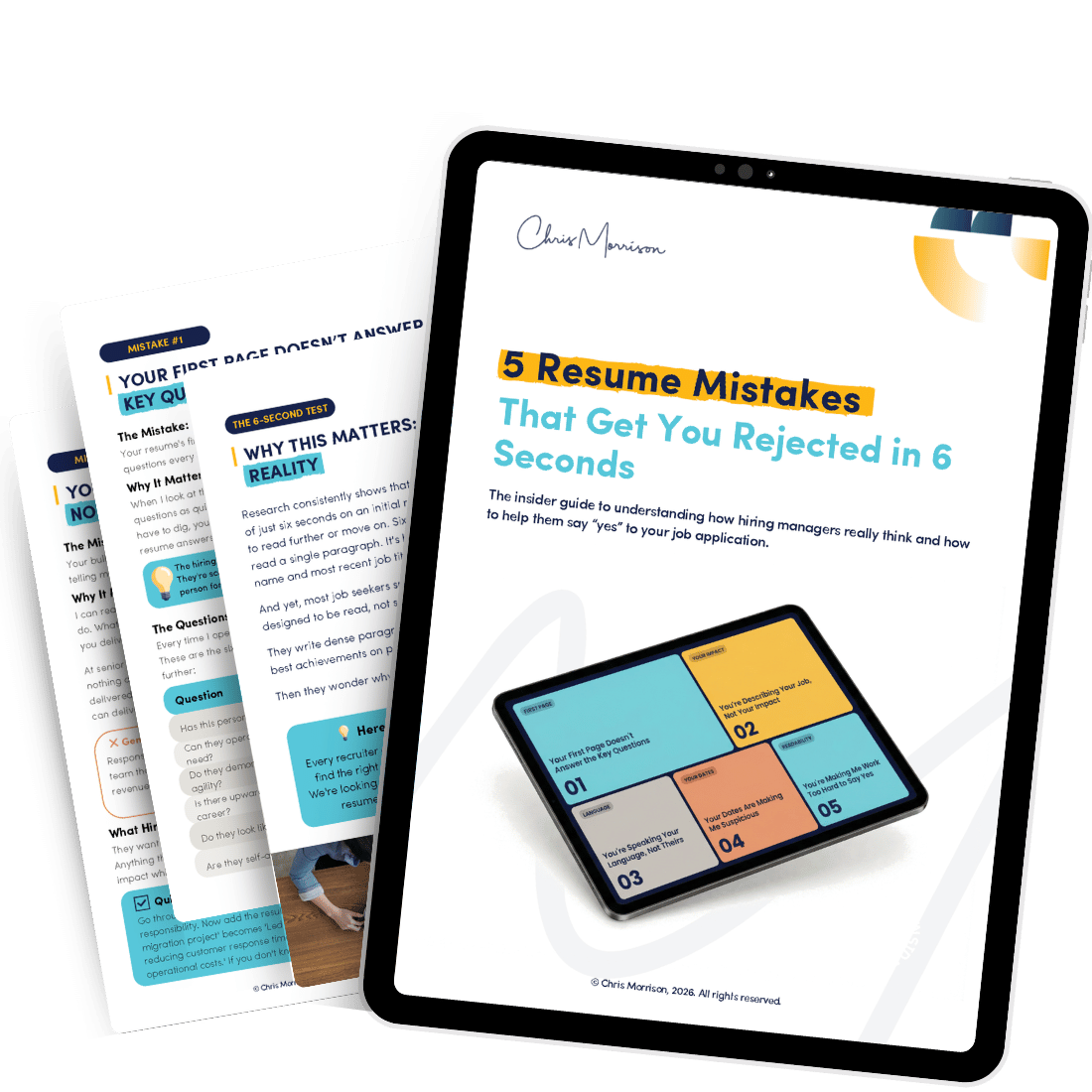
Most candidates make the same five mistakes that get resumes rejected in seconds. Find out what they are.
[1] Bertrand, M., & Mullainathan, S. (2004). Are Emily and Greg more employable than Lakisha and Jamal? A field experiment on labor market discrimination. American Economic Review, 94(4), 991–1013. Nearly 5,000 fictitious resumes sent to 1,300 employment ads.